

 Yesterday I had jury duty... at the University of Southern California Department of Landscape Architecture. I had the opportunity to critique (along with Mark Rios, Mia Lehrer, Clark Stevens, and other jury members) the final presentations for a landscape architecture studio co-taught by David Fletcher and Tom Leader.
I will provided an overview of the student projects next week... the studio was very interesting and the work of a high caliber... but today I want to talk a bit about the design education hazing ritual known as the "crit."
Critique, review, jury; these terms create anxiety amongst those who have pursued a design education - like standing before a firing squad. It is a test of ideas and presentation as well as an assessment of endurance and resilience. More than anything, it is intended as a learning experience.
My introduction to the crit was a shock… quite frankly, it was a set up. The introductory project of first year studio was a brief design exercise, I cannot remember the exact assignment. The project itself, it turned out, was irrelevant. The true purpose was a baptism by fire for us ignorant architect wannabes. We pinned up our work, excited by the newness of the experience, anticipating the opportunity before us.
The first victim was chosen - the sacrificial lamb for the class. After less than a minute the professor dramatically dropped his head, held up his hand and bellowed, "STOP," abruptly ending this eager young designer’s presentation. And so the lesson began. He was ripped up one side and down the other: his presentation was unfocused, his drawings incomplete and pinned up haphazardly and aslant. This was a lesson in how to present one’s self and one’s ideas - how to respect your own work so that your audience will respect it as well. The bar was set, and none of us had measured up… but now we had something to shoot for.
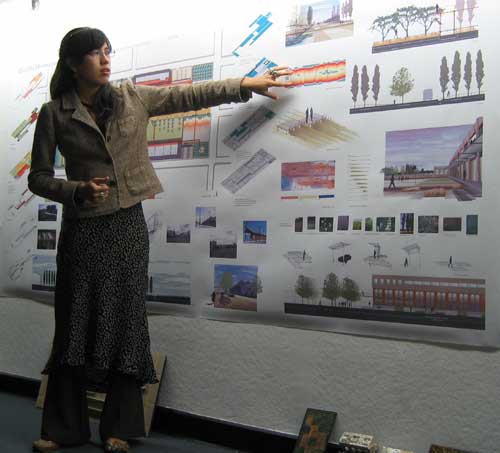
I suspect that many students are introduced to the crit in a similar manner. It is a sharp learning experience designed to push the younglings quickly out of the nest. In this way, it worked. The process of design is meaningless without communication - you must be able to clearly, effectively and aesthetically present your ideas.
School is a place to test ideas and to push the envelope, often the only reward for going out on a limb is to have your project trashed at the hands of an impatient jury. More thoughtful juries will engage in debate, discussion and criticism, though it may feel negative to the presenting student, a heated debate is a sign of a provocative project and provides a fertile ground from which to learn.
Of course there are jurors who derive perverse pleasure from flattening a student, using the crit as a means of feeding their own ego by delivering monologues filled with big words and obscure references intended more to impress their colleagues than to educate the unwitting victim. This seems to me to be the biggest problem with the jury method, tainting the experience and skewing the perceptions of what reviews are really about.
The problem with the system, beyond its nerve-wracking gut-wrenching nature, is that it sets up an atmosphere of animosity. It can feel like the jury is out to get you. The posture of defensiveness and a cloud of emotion can prevent useful lessons from being understood. To top it off, the design school culture of late nights and caffeine-sugar-drug fueled self abuse leaves most students exhausted and sapped by the time of their review.
Techniques were occasionally employed during my education in an attempt to deal with some of the problematic issues of reviews. Due dates set several days before the crit helped students to be at their best, refreshed and better able to present and to learn from the review. Cocktail party style formats worked with mixed results, allowing for one on one interaction between the presenter and the juror and removing the stage fright aspect of reviewing as well as the showboating of high ego jurors, but denied group interaction broader discussion.
To wrap this rambling quasi-sociological examination of the critique, I offer some advice for students:
-
Be open minded, yet invested in your ideas. Test and develop your ideas critically throughout the design process, and allow them to evolve.
Know what your project is about. This seems obvious, but it is so easy to get wrapped up in the project that you lose sight. Prepare a statement that briefly outlined what is important in your project so that the jury "gets it."
Be creative with presentation techniques, but be sure to organize information carefully so that the jurors can follow your thoughts. The further you deviate from traditional methods of representation, the more self-critical you must be.
Have fun. They jury is not your enemy, and they are not grading you. Loosen up, lighten up, and don't be intimidated. Be respectful and confident.
Listen. Learn from criticism and compliments. Correct misconceptions, but don't be belligerent.
Crits
Crits
There is no place for fear in learning.
Brownlab