Modern Garden Gazebo
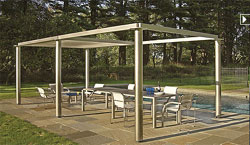 New from modern furniture designer Richard Schultz:
"Our new Pavilion is a modern garden gazebo designed to define space and create shade. The structure is 100% stainless steel with pleated vinyl mesh top and side curtains. Choose from our modular components to create your own layout."
Link: Richard Schultz
Master of complexity and spaciality in the landscape
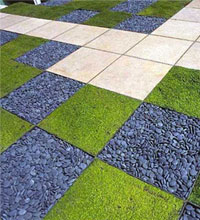 Well known and broadly published landscape architect Ron Herman has designed gardens for celebrities such as Joe Montana and Neil Young and for corporations and institutions such as Oracle and the National Gallery in Washington D.C. He studied with California landscape greats Garret Eckbo and Lawrence Halprin at Berkeley and went on to graduate school in Japan. These influences can easily be seen in his creative, expansive and dynamic landscapes.
We respect his attention to detail as well as his ability to manipulate space and layer a landscape in such a way that it feels larger than it actually is.
Firm: Ron Herman Landscape Architect
Three designers + Panelite = Sweet Results
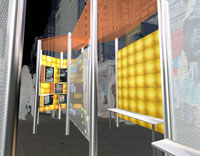 Interested in Panelite but not sure how to apply it? Looking for slightly different yet creative ways to use it? ID Magazine invited three designers to get creative with Panelite and the resulting concepts are "sweet".
"Bright, bubbly, and inclined to glow, Panelite panels make cheerful company. But this material is no floozy. Constructed of a honeycomb core of polymer, fiberglass, or aluminum sandwiched between fiberglass facings, it's strong and consistently rigid for its weight. A 4-by-8-foot panel, 3/4-inches thick, is 32 pounds, a feather compared to acrylic (144 pounds), or plate glass (316 pounds) in the same dimensions. What's more, the gumdrop colors and honeycomb cells produce vivid visual effects when light passes through the material.
What might other adventurous types do with Panelite? We asked the lighting designer Leni Schwendinger, industrial designer Gadi Amit of Newdealdesign, and graphic designer Mirko Ilic each to propose an application. They and their colleagues worked like drones to produce the concepts presented here."
Image: Leni Schwendinger Light Projects
Link: ID Online
Related: Panelite
Space saving stool that folds up to be stored in the closet.
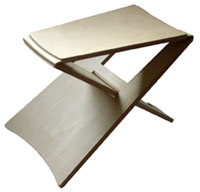 Innovative stool designed by Natalie Cole and Wayne Pottinger of the recently formed Also Studio. The stool, made from birch ply (have we already said how much we dig birch ply?), folds up for convenient storing when not in use.
Link: Also Studio
Via: Wallpaper
Minimalist light fixture
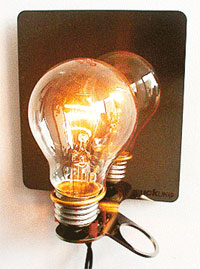 Interesting light design found over at Funfurde:
"The Low Volt Light from SuckUK is about as minimalist a design as you'll see. There's no shade and no on/off switch, just a bare bulb and two hoops of wire. Put the bulb in one hoop and it turns on, put it in the other and it turns off. (Okay, there are a few more parts, like a cord so you can plug it in and a shiny reflector plate. But that's it. Really.)"
Via: Funfurde
Link: Suck UK
...they may actually create significant buildings. Neutra's Cyclorama Center slated for demolition
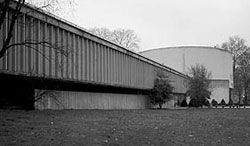 According to John Latschar, superintendent of Gettysburg National Military Park, the architects hired during the Mission 66 program "ran amok." The Mission 66 program implemented under Eisenhower produced, in addition to Neutra's Cyclorama Center, the Gateway Arch in St. Louis by Eero Saarinen.
The LA Times ran an article yesterday by Mark Rozzo entitled Who Chooses History?
The National Park Service Has Decided That L.A. Architect Richard Neutra's Landmark Cyclorama Center--Which Has Stood at the Gettysburg Battlefield for More Than 40 Years--Now Detracts From the History.
Richard Neutra's son Dion, who is also an architect, is fighting the impending demolition of the "Abraham Lincoln Shrine of the Nation." Besides running amok, the other great quote from the LA Times article is this one from Mr. Latschar, "Mr. Neutra had the idea that this would be his monument to Lincoln and freedom and all that stuff." Yeah, why bother with all that stuff?
Article: LA Times
Link: Richard and Dion Neutra Architecture
Link: Mission 66: Mid Century Modern Architecture in the National Parks
A classic <del>in chrome</del>
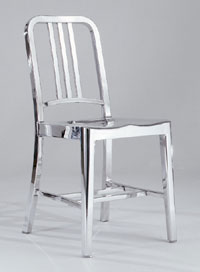 We've always loved the simple lines of the Emeco Navy chair. After looking up some info on Gehry's new Superlight chair by Emeco, we came across a picture of the Navy in polished
 chrome aluminum. Then it struck us: if our greasy fingers turn the polished backing of our iPods into a total mess after a few handlings, just imagine what these chairs will look like after a day or two. As beautiful as they are, our advice to you would be to order a big ol' bucket of chrome polish to go with your new chairs. Or, just don't touch or sit on them.
Oh, and as for the Superlight? Well, the jury is still out on that one. Ok, to be honest, we're not crazy about it. Which leads us to wonder how Joe's performance on the Navy would standup against a similar performance on the Superlight. Hmmm, Joe?
UPDATE: Today we received an email from Dan Fogelson, VP of Sales and Marketing for Emeco. He wanted to inform us that we incorrectly described the Navy as "chrome" when in fact it is highly polished aluminum and very easy to keep clean. Here's what Dan had to say:
"Thank-you for your mention of Emeco on your site. Emeco makes 100% aluminum furniture - we do not chrome plate our products (a process that is environmentally dangerous and temporary). The photo you show is of a hand polished aluminum Navy chair. Simple Windex or other non streaking cleaner keeps it looking great. Next time you are in NYC, stop by the Hudson hotel where our polished chairs have been used continuously for close to five years. And if you are in the US, I'd like to show you the new Gehry Superlight T chair for your review now that it is in production."
Thanks for setting us straight on the Navy, Dan, and we'll be sure to get in touch with you about the Superlight.
Link: Emeco.net
Link: Emeco Superlight Press Release
Link: Book of Joe
Finally....
Well, now that we've been online for just about two months, we decided it was about time to turn on the ability to receive reader comments for our entries. In order to submit a comment, all you need to submit is the comment itself. We ask for your name but it's not required (we'll automatically fill in "Anonymous" as your name if you chose not to include it). Also, we won't ask for your email addres, nor do we require that you provide a title. However, we'd prefer that you did, but it's up to you.
With that in mind, please keep your comments on-topic and relevent to the blog entry. Any comment that is off-topic, deemed offensive, or is thought to be spam will be removed.
If you wish to contact us, please do so via our contact form and we'll get back to you as soon as possible.
Thanks again for reading Land+Living!
Translucent furniture by architect Jeanne Scandura
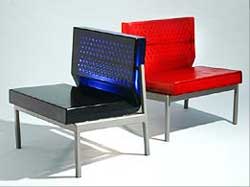 The Tread line of funky translucent chairs and cubes stands in contrast to the sculptural and graceful Wave line of furniture also by Float that we featured a while back. That's what we like about Float, they design furniture that shares a common spirit, but a that has a completely different feel and look. Both the Tread chair and cube come in a variety of translucent cast rubber colors.
Link: Float
A sustainable urban dwelling in Minneapolis
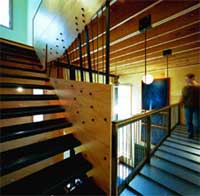 Locus Architecture has created an updated bungalow style home constructed in a manner that reduces the waste and negative environmental impact inherent in standard construction practices. And... it's for sale!
It’s a synthesis of fanciful urban loft and practical family basecamp. Kaleidoscopic art and green design. Radical new techniques and reused materials. Welcome to nowhaus 01: the first in a series of singular homes that celebrate modern, sustainable city living—conceived and built by LOCUS Architecture. This dramatic rebirth of a 1950s rambler near Cedar Lake manifests our core principles—and some of our most intriguing ideas.
Link: NowHaus
Firm: Locus Architecture
Chicago-based photographer/designer
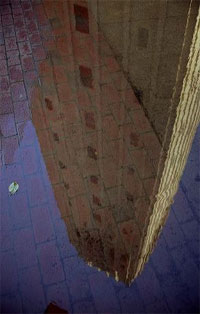 When we saw the work of this young photographer, we felt as if we had found a kindred spirit... though one who is truly a photographer and not just someone who loves to document everything with photographs as we do. Some of his work made us think of the photographs we love by Charles and Ray Eames. We truly admire Pete's eye for capturing the extraordinary, humorous, and sublime in the ordinary environments that surround us.
In addition to his own very nicely designed online portfolio, some of his work is featured on fStopImages.
Peter Baker is disarming. The youngest contributor to the fStop collection, his work is a synthesis of studied professionalism and youthful exuberance.
Link: Peter Baker Photography
Link: fStopImages
Exhibition at the Austrian Cultural Forum New York: June 24 - October 30, 2004
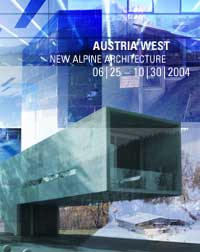 To follow up on yesterday's post, more modern alpine architecture. This time an exhibit which runs from today through the end of October in New York, and then moves to Helskinki.
The first American showcase of the varied and energetic architectural scene flourishing in Austria's two exquisite, westernmost mountain provinces of Tirol and Vorarlberg. Featuring the work of 26 individual architects and firms, Austria West presents an array of models, drawings, photographs, and other documentation, revealing the ways in which architects in these two very different regional cultures have together forged a new Alpine modernism of international relevance.
Link: Austrian Cultural Forum
Link: Austria West
"Floating above the ground"
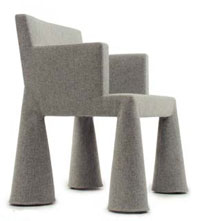 "The VIP Chair was especially designed for the World Expo 2000 in Hanover. It was used in the VIP room at the top of the Dutch Pavilion. The VIP Chair is now part of the Moooi collection.
The chair is completely upholstered with a woollen, felt-like textile, available in a few different colours. The upholstery covering the legs of the chair hang loose, like trouser legs. Thanks to hidden wheels, when the chair moves it looks like it's floating above the ground."
Designer: Marcel Wanders
Link: Moooi
Do-it-yourself lamp shade made from your old slides: "Linked slides create a colorful indoor escape"
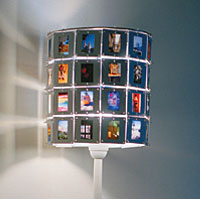 Check out this little project from ReadyMade magazine for an inexpensive and personalized lamp. We haven't tried it ourselves, but we think it looks pretty cool... and plus, we were looking for a weekend project.
Link: ReadyMade
Competition for a mountain resort in Östersund, Sweden
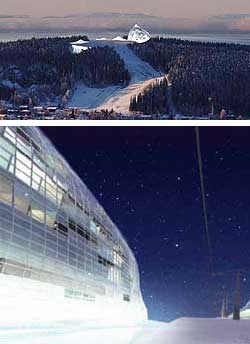 As snow sport enthusiasts, we are always intrigued by modern alpine architecture since the vast majority of mountain architecture is heavy timbered and rustic. This competition seeks to put a Swedish resort on the map with an enormous mountaintop complex featuring a hotel, 3500 seat auditorium, restaurants, spa, ski facilities, etc.
The winning entry called Biesse-Baenie by Swedish firm Wingårdh Arkitektkontor is a stunning topographic design that extends the slopes and ski lifts up onto an artificial roof landscape punctuated by organic crystalline mounds forming sky lights and the hotel building. The gondola sweeps from the town square at the foot of the mountain and up into the main lobby space of the new building.
The other proposals are also very interesting, but we agree with the jury; the Biesse-Baenie proposal is outstanding.
Link: Breath of Life
Firm: Wingårdh Arkitektkontor
Modern housing "community without comformity" in Southampton, New York
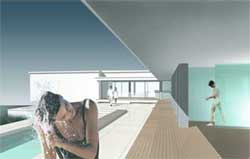 The first group of houses is under construction and "Sagaponac House-43" by Hariri & Hariri has just been completed.
The Houses at Sagaponac is a residential development in the Hamptons on Long Island, New York. It is a sort of who's who gallery of starchitects all building in the same neighborhood. The idea is to create something in contrast to the recent proliferation of shingle style "McMansions" inspired by another starchitect with a more historicist bent, Robert A. M. Stern.
The houses themselves are all designed to create modest, functional, single-family living spaces from 2,000 to 4,500 square feet that are environmentally conscious without compromising artistic vision.
Apparently $1.4 - 2.9 million for a house is modest in the Hamptons... anyway, there are some cool designs to be built and we applaud the landscape plan for the development which emphasizes indigenous vegetation and eschews planting of vast ornamental lawns.
Via: Architectural Record
Link: Houses at Sagaponac
Firm: Hariri and Hariri Architecture
An exhibition of Europe's worst interiors of 1974
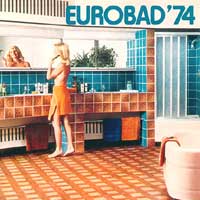 So bad it's good. Yeah, there is some bad stuff in here, but then again, we kind of dig some of the ideas. It begs to be said... totally groovy. Can we help it if we are children of the ´70's? Just wait until we are looking back at 2004 in thirty years. Seriously.
Link: EUROBAD '74
Via: Things Magazine
Architects and students challenged to design the seminal single-family home of the 21st century
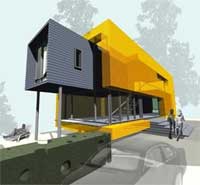 This competition sponsored by the AIA Committee on Design produced some interesting results. Entrants were asked to "explore the impact of their designs relative to sustainability, economics, and social issues." First place (design shown at right) was awarded to a team composed of Jeffrey S. Lee, AIA; David Hill, Assoc. AIA; Matthew Konar; Jennifer Olson; Nelson Tang; Marni Vinton, and Holly Williams.
Link: AIArchitect
The ability to get from point A to point B makes a "Great City"
More on urban planning issues... if you live in an urban area, then you most likely know how bad traffic can be (and how it is getting worse) and how it impacts your quality of life. We certainly make decisions about where to go, and where NOT to go based on the ease of travel and the congestion we will encounter. We ran across this article about the future of Houston based upon planning decisions the city is facing today. It is an interesting look at a typical American city and the issues of sprawl, increasing population and quality of life.
Looking back, the critical turning point was when people realized mobility investments were crucial enablers of quality of life, not detractors. Mobility is the lifeblood of our city. When it deteriorates and going places becomes just too much of a hassle, the loss is subtle but significant: the lunch with a friend not taken, the handshake business deal not made, the romantic dinner forgone, the family outing canceled, the volunteer or charity event missed, or that great little hole-in-the-wall restaurant that slowly dies because customers can't get to it. Real quality of life is when people can make connections to other people the true essence of any city. Great cities — world-class cities — are not a closed collection of isolated islands. They are open cities. Connected cities.
Via: Houston Chronicle
Modern Tokyo urban development designed by Fumihiko Maki unfolded over the course of 3 decades
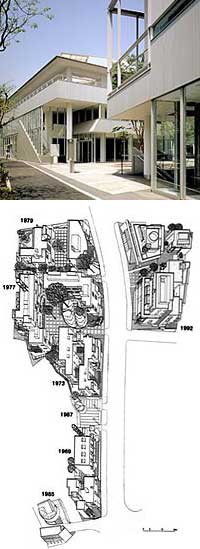 This complex of apartments, shops and offices has all the elements of so many "mixed-use" developments which are cropping up in the United States recently, but with a few key differences. First and foremost, the complex has been built over the course of three decades, expanding and adapting with time. In addition the design is modern, the scale is intimate and the result is brilliant.
The basic idea is intelligently urban (an early modern New Urbanism) with much attention paid to the "interaction of facade and street space, understanding the sidewalk as a place of activity." The development also features a network of paths and stairways which connect the various levels of the hillside complex and provide pedestrian circulation through the site.
What is remarkable is that the complex blends so well into its context without resorting to pseudo-historicism. If only more American cities and developers would learn this lesson of incremental development and detailed place making.
Firm: Maki and Associates
Link: Hillside Terrace
The Venture Collection
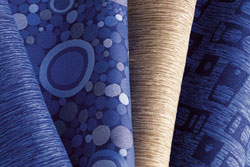 "New techniques now allow recycled polyester to be created with a softer texture and hand. Insight is an effervescent yet soothing design of variously sized circles suggesting both creative process and contemplation. Gizmo, an amusing pattern whose motif brings to mind a non-specific bit of technology, is woven from a bouclé yarn for a level of texture unusual in recycled polyester. Mindscape is a sophisticated alternative to a solid or a pattern, a dreamy texture that makes the perfect background for any flight of the imagination. All three patterns are created from the same new, cleaner, and forward-thinking technology, yet most impressive of all, are colored with the usual high Unika Vaev standards and fit seamlessly into the Collection as a whole."
Designer: Dorothy Cosonas
Link: Unika Vaev
Beautiful bentwood chair from Bernhardt
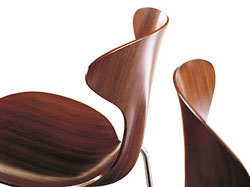 From Bernhardt Design comes the Orbit chair. Designed by Ross Lovegrove, this chair is part of their "Guest" collection.
Designer: Ross Lovegrove
Link: Bernhardt Design
Longtime Chicago mayor has vowed to make his city the greenest in the nation.
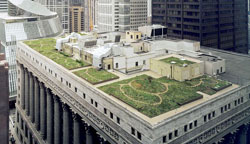 Lisa Chamberlain at Metropolis writes:
"On March 30, 2003, in the dead of night, a bulldozer lumbered through downtown Chicago toward its much celebrated lakefront. Dispatched by Mayor Richard M. Daley with a police escort, it turned onto a 90-acre peninsula, home to a tiny airport known as Meigs Field, and without warning, plowed giant Xs into the airport’s single runway, rendering it useless. Chicagoans were stunned by this seemingly bizarre act of destruction. Mayor Daley said the war in Iraq and fears about airport security were the reasons for bulldozing the runway. This brass-knuckles move, however, stranded 16 airplanes—infuriating the corporate community and cementing Daley’s reputation as an autocrat. Of course, it’s not unheard of for unilateral action to be justified in the name of national security, even if the real motive turns out to be quite different. So what was the mayor’s strong-arm tactic really about?
Believe it or not, a simple park."
Link: Metropolis
Washington Post writer Joel M. Lerner writes about the increase in requests for "natural" solutions to landscape opportunities and problems amongst his columns. In the article, he covers native plants, annuals and perennials, pest management, and more.
"When you work in a field for a long time, it can seem that the same things happen, day after day. But occasionally, it's a good idea to sit back and take a look at what has been going on. A couple of rainy days recently gave me some time to look over the topics of my roughly 400 columns and identify some new threads in the landscape fabric. For instance, I noticed an increasing desire in recent years for "natural" solutions to landscape opportunities and problems. Here is more on that topic and other topics of increasing current interest."
Link: Washington Post
Custom Modular Homes
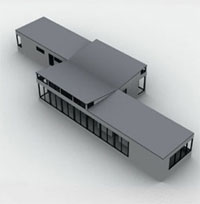 "The 2 Bar Slip is anchored by a central living space with windowed views in every direction, perfect for a site with desirable views in multiple directions. The central living-dining-kitchen space opens at two corners to bright windowed halls that lead to bedrooms. This space creates a cross-directional axis that is further implied by tilted roof and ceiling planes, opening the interior to the outside.. The two separated wings of bedrooms allow the house to easily sustain a large family, or work as a shared duplex residence."
Link: Resolution 4: Architecture
Eggs and birds are beautiful
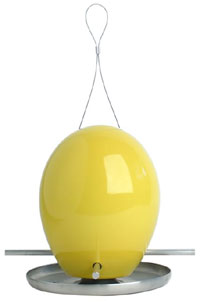 "Egg Bird Feeders attract many types of wild birds and the elegant, clean design is a perfect addition to any outdoor environment. The handmade Egg Bird Feeder is also easy to use, durable and gray squirrel proof."
Link: eggbirdfeeders.com
The philosophy of minimalism
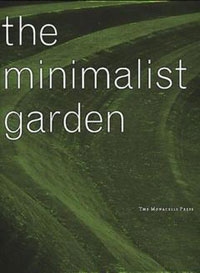 "Award-winning garden designer Christopher Bradley-Hole has drawn together a great variety of minimalist gardens from around the world - large and small, urban and rural. The projects are grouped into thematic chapters, including the landscape garden, pools and water gardens, courtyard gardens, and terrace and roof gardens. Among the designers are Vladimir Sitta, John Pawson, Luis Barragán, Seth Stein, Jacques Wirtz, Martha Schwartz, Shodo Suzuki, and Isamu Noguchi. Large color photographs and detailed images show the gardens in context; the text discusses the inspiration behind each garden, the relationship of space and proportions, and the frequent use of unusual materials and imaginative planning. Directories of materials and plants for the perfect minimalist garden are included as well."
Author: Christopher Bradley-Hole
Link: Booklounge.com
LA Times architecture critic Nicolai Ouroussoff reviews Daly Genik's new Art Center building
Unfortunately the Calendar Live section of the LA Times not only requires a password, but it is a separate registration from the regular LA Times sections. Anyway... today's Calendar section features a review of the new Art Center College of Design South Campus in Pasadena, California designed by Daly Genik which we featured last week. The article is articulate and wonderfully descriptive, and the print edition features some nice photographs.
Art Center's new South Campus in Pasadena transforms a site of industrial desolation into a metaphor for our times.
The design proves that desolation and decay can be virtues. A subtle balance of grit and elegance, the building draws on the wonderful moodiness of its setting. Old forms are carved up with surgical precision; new forms are imbued with palpable energy. The result is a building that is both emotionally raw and marvelously unpretentious.
Link: LA Times Calendar Live (registration required)
Reference: The Wind Tunnel
Textile patterns designed by Bruce Mau
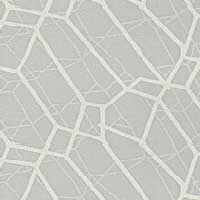 "Bruce Mau Designs collaborates with some of the world's leading architects, artists, writers, curators, academics, entrepreneurs, businesses and institutions." Just a couple of his well known designs are the font commissioned for the Walt Disney Conert Hall in Los Angeles (yes, a Frank Gehry connection) and the design for Rem Koolhaus's book S, M, L, XL. How about a little Bruce Mau on your couch? He has created several panel fabric patterns for Maharam.
MegaNano by Bruce Mau challenges the predictably static appearance of panel fabric in the corporate office environment with the introduction of two series of patterns, each centered on a singular theme presented in macro (Mega), micro (Nano) and mixed (MegaNano) scales. Constructed with 100% post-industrial recycled polyester, MegaNano Structure, Mega Structure and Nano Structure depict an elemental organic grid, while MegaNano Point, Mega Point, Nano Point and the over-scale Giga Point are based on perforated punch cards that recall the origins of our computerized society.
Maharam also produces textile patterns by such designers as Charles and Ray Eames, Hella Jongerius, George Nelson and Verner Panton just to name a few.
Link: Maharam
Designer: Bruce Mau Design, Inc.
The Sam and Alfreda Maloof Foundation for Arts and Crafts
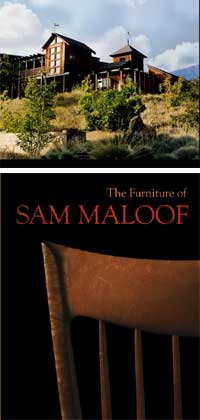 Sam Maloof is well known as a master craftsman and designer of contemporary furniture. His works are featured in the permanent collections of many of museums, including, the Smithsonian, the New York Metropolitan Museum of Art, the Los Angeles County Art Museum, Boston's Museum of Fine Arts and the Philadelphia Museum of Art.
Now through the Maloof Foundation, the Maloof's home in Alta Loma, California (east of Los Angeles), is open to the public. The home evolved over many years and was crafted by Sam Maloof as if it were a giant piece of furniture.
Link: Maloof Foundation
Book: Amazon