German artist
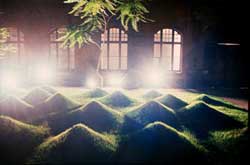 Susanne Lorenz is a Berlin based artist who's work explores the boundaries of landscape, architecture, urbanism and the public realm. Her projects include a wide variety of installations, public sculpture, objects, and architectural projects.
Link: Susanne Lorenz (German)
Contemporary Lighting and Lamps
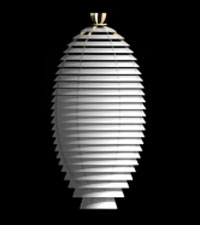 Lighting and lamps from Austin based Kamelyon Design.
"Kamelyon Design is a design and manufacturing studio that specializes in custom handmade fixtures and shades. Brett Grinkmeyer formed Kamelyon Design in early 2000 to pursue his interest in furniture and lighting design. Kamelyon Design combines his skill as a designer and his passion for fine craftsmanship. The light sculptures have received acclaim not only for their unique designs, but also for their innovative construction. Mr. Grinkmeyer makes each one of the lamps by hand insuring the highest level of quality possible. The goal of Kamelyon Design is to break new ground and to create truly unique designs that stir the soul – designs that transcend fad or fashion."
Link: Kamelyon Design [Thanks, Brett!]
Cutting edge in contemporary architecture
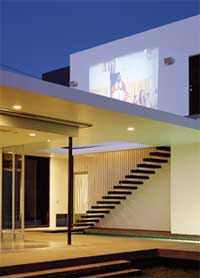 "Each year the American Institute of Architects Los Angeles Chapter recognizes significant achievements in local architecture at their awards gala, held this year at the California Science Center School.
Winning projects represent the cutting edge in contemporary architecture, interior design and historic restoration, selected by a distinguished jury of local and internationally known architects."
Some of the winning firms include:
SPF Architects
Kanner Architects
Lorcan O'Herlihy
Pugh + Scarpa Architects
Link: AIA LA
Via: Royal Homes Toronto Studio
Elastic Shelving
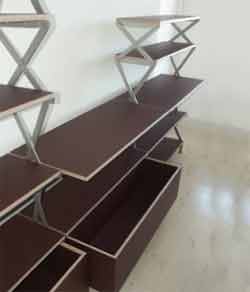 New Shelving from Shapes-Design:
FUN - designed by Alessandra Maiolino - is a pioneering and exquisite elastic shelving system. Modular stainless steel elements innovatively combine with beautifully fashioned shelves, made from plywood with sensuous linoleum faces in various colours. Because FUN does not rely on uprights of fixed lengths, it enables you to shape it into a number of highly versatile combinations, with different numbers, heights, and widths of shelves. FUN is easy to transport, assemble, and mould to your changing needs and aspirations. It is available for both the home and commercial application.
Designer: Alessandra Maiolino
Link: Shapes-Design
Truly modern dog beds.
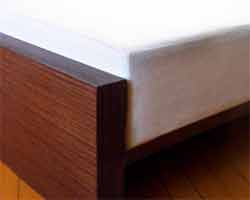 Even though my dog would prefer to sleep in a tent rather than sleep in a bed, I'm sure once he got used to it he'd be right at home in Teak Dino from Bark Deco.
Bark Deco makes modern doggy beds in three styles availble in a multitude of fabrics and wood veneers.
bark deco beds are designed to provide the ultimate in modern style and luxury for the special members of your family. every bark deco bed is handmade from start to finish. the platforms are constructed from birch hardwood with the care and attention to detail given to fine furniture.
exotic wood veneers are applied and finished by hand over the course of several days. veneers offered in the debut collection are wenge, zebrawood and teak. all bark deco beds measure seven inches tall (regardless of size). each model features a ventilated platform and is elevated for style and comfort (no drafty floors). rubber feet are added to help keep the bed in place.
Link: Bark Deco [Thanks, Joyce!]
Low-cost housing
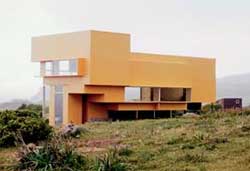 The feature article this month at Domus highlights a group of Chilean architects and their system of designing low-cost housing.
The M7 prototype is the result of a slow process of research and development, begun in 2001 by the Chilean architects’ cooperative URO1.ORG. Its aim was to find modular construction solutions that would allow users to freely configure and construct their own small-scale architecture. The weekend home, located at Tunquén on a green plateau facing the Pacific Ocean, was used as an experiment to study a variety of possible materials and to perfect assembly methods based on extreme simplicity and practical economy.
Full article available at Domus.
Firm: URO1.org
Via: Domus (Registration Req'd)
Multifunctional living concept
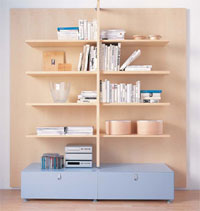 From designer Peter Maly comes Minos.
"Menos is the answer to the challenges of modern life. Living areas are not sectioned off, but rather they merge into each other. The multifunctional concept provides you with the freedom to use living areas more effectively and more creatively too. With innumerable combinations, use Menos to create new designs over and over again: closed and open elements, drawers, shelves and containers always adapted to your respective requirements. Whether in living, sleeping, or dining areas, meonos creates rooms and defines the harmonious unity of living in general. A feeling of feeling at home."
Designer: Peter Maly
Link: House of European Design [Thanks, Aliona!]
Mountain residence negotiates steep wooded site
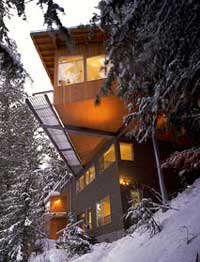 Seattle based E. Cobb Architects create regional modern design solutions with an emphasis on space and material. We admire many of their projects, many are more eye catching, but his one in particular is of interest to us because they way that the design responds to specific site conditions over formal considerations.
Located on a lake front site in the Cascade Mountain Range, the house navigates an extreme topography drops 54 feet over 126 feet in distance from the road to the lake shore. The house negotiates the slope and the "occupyable spaces high in the tree branches" with minimal site clearing or grading.
Firm: E. Cobb Architects Inc.
Striking and simple solution by Lekker Projects
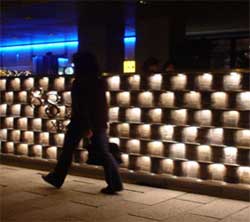 We've said it before, but we must say it again: it is the simple solutions that we often find to be the most elegant.
In this case, Lekker Projects, a small environmental design firm with offices in Shanghai and Singapore, was faced with the problem of correcting bad Feng Shui while creating a distinct signage element for the 88 Xintiandi Hotel in Shanghai. The solution was to use Chinese roof tiles (the symbol of the hotel) in an inventive way to create a simple but striking result. The form of the tiles are instantly recongnizable, but their application is inspired.
Firm: Lekker Projects
Link: 88 Xintiandi
Contemporary bamboo home accessories
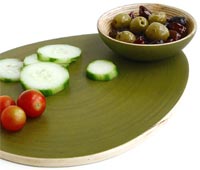 Lately, it seems as if bamboo products are popping up everywhere and obviously for good reasons: It's a fantastic material to work with and it replenishes itself in half the time as other wood (yes, we know it's technically a grass). On that note, Ekobo has an entire product line crafted from bamboo. Trays, bowls, and stools to name just a few.
Made of eco-friendly bamboo, ekobo is a line of contemporary tableware designed in France and hand-crafted in Vietnam in respect of the rules of equitable commerce.
Designer: ekobo
Link: illico design [Thanks, Thomas!]
Not exactly modern, but definitely retro cool.
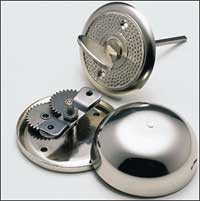 Imagine for a moment that you had one of these retro-cool turnkey doorbells installed in your place. How many people do you think would have no idea how to use it or for that matter, even know what it was? I can see it now, "look at this guy, his deadbolt was installed the wrong way!"
This is really what used to be a corridor bell, as it was originally used for flats in apartment blocks. But the neat bell mechanism, made completely without the use of plastic components, can also be heard in the average-sized family house. The key twist mechanism is designed to fit doors of 6 cm thickness, but can be shortened for thinner doors by cutting the square shaft with a hacksaw. The quality nickel-coated steel plate bell can also be mounted outside.
Link: Manufactum
Via: The Red Ferret Journal
Move over MD-100, there's a new shed in town.
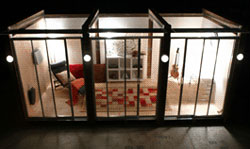 This is the first we've heard of the Metro Shed, but at first glance, it looks to offer a nice alternative for those of you contemplating a new backyard pool house.
The MetroShed idea grew from the need to have a quiet, detached living / working space close to home. The MetroShed is a modern outdoor structure created using top quality wood, glass, aluminum and acrylic building materials. The MetroShed is sold as an unfurnished shell, or fully furnished ready to enjoy. The MetroShed can also be customized to match existing modern contemporary residences.
The Metro Shed can also be customized to match your modern home.
Link: Metro Shed [Thanks, Donovan!]
Victoria Gardens: the illusion continues in Rancho Cucamonga
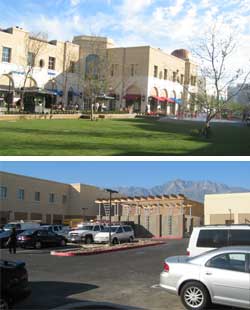 Victoria Gardens is not a ground breaking step in the evolution of malls. The idea borrows from New Urbanist concepts fused with the concepts or retail design explored by John Jerde. Similar to Jerde’s work, Victoria Gardens is, to borrow the words of Margaret Crawford, "between the commercial and the artistic, the popular and the pure, and, of course, the high and the low."
But Victoria Gardens is no City Walk, its ambitions are much less hyper-realistic, and perhaps this is what sets it apart from many other themed malls that we have seen. But the result is a somewhat duplicitous place that insists it is one thing when it is actually something else.
Link: Victoria Gardens
Reference: Downtown Mauled - Part I
Victoria Gardens: suburban mall impersonates a town center in Rancho Cucamonga
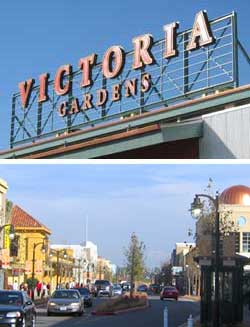 This former agricultural center 50 miles east of Los Angeles was once home to sprawling groves and vineyards, but has been more recently known for the sprawl of big-box mini-malls and cookie cutter tract homes. Now a new development seeks to be the downtown that Rancho Cucamonga, California has never had.
The New York Times saw fit to cover the opening of this new mall, so we figured that it was worth the 40 minute drive to check it out. City planners had originally envisioned a more traditional mall, but the developers had a bold idea that breaks many (though not all) of the rules of the typical mall development. The idea behind Victoria Gardens is not new, pseudo-historic town centers are the core of most New Urbanist neighborhoods, but here it has been inserted into an existing tract home city.
The name of this mall betrays its form; all of the shops are located along an urban grid of streets open to vehicular traffic, complete with parking meters and sidewalks. Parking lots and service areas located in the center of the blocks, much like a traditional American town. "Victoria Gardens" fails to provide a hint of the urban space that has been created, or perhaps this was an intentional move to calm local residents who may fear density.
Link: Victoria Gardens
Article: New York Times -
A Different Sort of Mall for a California Town
Reference: Downtown Mauled - Part II
Developer: Forest City Enterprises with Lewis Retail Centers
Masterplan and Design Concept/Design Architect: Field Paoli
Executive Design Architect: Altoon & Porter
Executive Architect: KA Architects
Design Architect: Elkus Manfredi Architects
Landscape Architect: SWA Group
Good design for everyday.
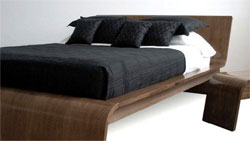 Area Home is a NY based company that specializes in bedding and home accessories with a Scandinavian flair. In addition to some terrific bedding patterns, they also make a great bed and matching tables.
Sheets and pillows come in thread counts ranging from 200 to 300. Bed and tables are made from bent ply with walnut veneer.
Link: Area Home [Thanks, Scott!]
The Pefect Shape.
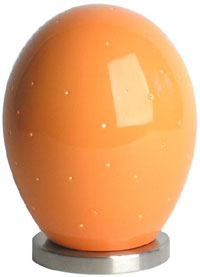 After we featured the Egg Bird Feeder back in June, we know you all ran out and got one. Well, guess what? Now, you can have the perfect accessory to complement your feeder.
J. Schatz has come up with not one but two lamps shaped just like your favorite bird feeder, a shade lamp and a nightlight.
Read a book next to an Egg Shade Lamp or lie in bed and stare at a ceiling full of stars with the Star Egg Nightlight. Available in nine colors and three exquisite finishes: Lush, Exotic and Crackle.
We'll take a lush orange peel star nightlight, thanks. Speaking of eggs, a former graphic design instructor of mine once claimed that the egg was the "perfect shape." Thought you'd like to know.
Link: Egg Lamps
Related: Egg Bird Feeder
Showing what wood really looks like.
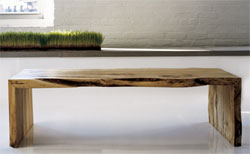 Combining the natural beauty of wood along with the occasional glass adornment, John Houshmand has created an appealing line of modern furniture. His line features a range of furniture from side tables, low tables and dining tables to to benches, beds and shelving. His philospy is literally "to show what wood really looks like."
Our favorite pieces include the spalted naple low bench/table (featured at right) and the black walnut table (middle image featured below).
Link: John Houshmand
Like The Art Book, but greener.
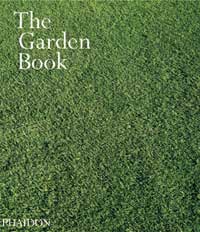 "The Garden Book presents a widely diverse range of designers responsible for some of the most interesting and iconic gardens and landscapes of all time from around the world. Gardens of Ancient Persia, the Moguls of India, and the palaces of Chinese Emperors sit side by side with contemporary gardens from the USA and Europe.
Like The Art Book, this book presents 500 designers in an AZ format that departs from the usual emphasis on genres and time periods. The gardens are carefully selected to choose the appropriate work for key figures which illustrates their influence on the traditions of gardening in many countries around the world. They range, therefore, from the palaces of kings to the all-consuming passions, bordering on obsessions, of amateur enthusiasts."
Link: Phaidon Press
Link: McNally Robinson
How 34 LA architects approach their work
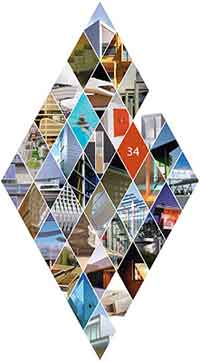 Exhibition at A+D Museum in Los Angeles running November 18, 2004 through February 22nd, 2005.
The exhibit is a preview in support of a new book to be published by Balcony Press and scheduled for release in the Fall of 2005 – entitled “2000 + New Architecture from Los Angeles”. The book’s editor is John Chase.
Each participating architect has fitted the presentation of his work into a diamond-shaped 6 ft x 2 ft “tower” designed by Lorcan O’Herlihy, AIA. The towers are mounted on wheels, arranged randomly, and can move around the room. This affords the viewer a walk through the exhibit non-sequentially, much like walking through a forest of trees. Each firm’s viewpoint is contained within the tower and may be studied from all angles by a single viewer, or by a group of viewers, thus presenting an opportunity for discussion.
Link: A+D Architecture and Design Museum
Modern landscape design aesthetics meets environmental sensitivity
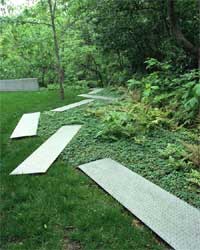 Lush modern landscape from NY based firm Michael Van Valkenburgh Associates.
The Garden on Turtle Creek, started in 1997 and completed in May 1999, is a model for the union of modern landscape design aesthetics and environmental sensitivity. Weaving new landscape elements into the sites natural systems and intense native vegetation, the garden mediates two strong contextual forces: the sophisticated glass, limestone, and concrete house, designed by Antoine Predock from 1987-1993, and the unpredictable site condition of a steep, richly vegetated slope that descends into Turtle Creek.
Link: Michael Van Valkenburg
Geppetto Design Studio, Budapest
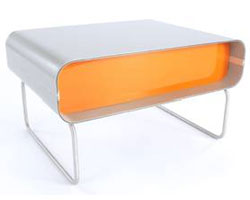 We're not too familiar with the contemporary Hungarian design scene... actually, we didn't really even know there was one. That sounds a bit ignorant, but apparently we've just not run across any Hungarian designers recently. Never the less, we're digging the work of Budapest based designers Elek Márton, Elek Máté, Buzogány Ildikó of Geppetto.
Their designs run the gambit of interior furnishings, fittings, accessories and interior designs. Their styles is clean and fun, and somehow familiar... could it be that we have seen Geppetto's work before and just not known who they were? Check them out... and please do take note, won't you?
Link: Geppetto
A limited collection from Nikolas Piper
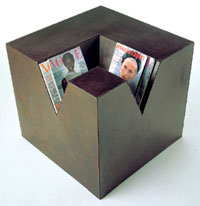 The Olman side table (featured at right) is just one of many pieces crafted by Nikolas Piper and on display at niksproject.com.
"Nik's Project presents a limited collection of pieces designed by Nikolas Piper for specific projects ordered by foundations and private institutions. The combination of traditional forge and modern technologies which Nikolas combines in his designs create these timeless pieces of furniture whose outstanding features are their organic, sensual and functional characteristics."
Also from Nikolas comes "Alice's Legs", a beautifully crafted chaise lounge constructed from high-end teak or birch laminated wood with iron fittings and stainless steel.
Link: Nik's Project
Link: Alice's Legs
Santiago, Chile based Architect
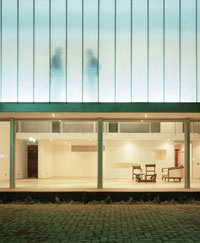 It is always interesting for us to "discover" to work of an architect outside of our usual sphere of influence (our sphere based from Los Angeles, California).
We recently came across the work of Chilean architect Felipe Assadi and were impressed with the quality of work produced by his five person firm. We think that his work holds its own compared with work by European and American architects with whom we are better acquainted and certainly deserves some attention.
Link: Felipe Assadi
Time machine to 1957 not included
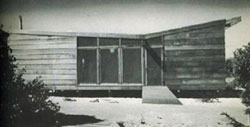 Another great book from our friends over at DigModern. Written in 1957 by Norman Cherner, this book explores small component housing from the 1950's.
An excellent look at small, modernist component built houses by the architect Norman Cherner. Divided into chapters as follows: Plans and intro, Panel Construction, Bent Construction, Girder Construction, Masonary and Foundation Construction, Quonset Construction, Materials and Methods. Excellent isometric drawings and details by the architect. Also sections, elevations, and floor plans. Black and white photos of homes under construction and finished.
Link: DigModern
Another great example of reuse: recycled chopsticks.
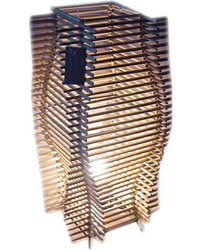 While some might not consider these lights to be pure "modern" design, they are definitely eco-friendly and that's good enough for us. While living in China, Bryan Parks, the founder of Kwytza Kraft, wondered just how many single-use chopsticks were used in the country. Turns out, it's quite a lot:
Research showed that literally billions of single-use chopsticks were consumed annually. The more shocking revelation was that it took, by some estimates, 25 million trees and bamboo plants to support that resource waste. Was there an opportunity to use the chopsticks for other applications that would provide a consumer benefit while bringing awareness to the negative environmental impact of single-use chopsticks?
With a virtually unlimited resource of chopsticks at his disposal, he began designing a collection of home accessories with "eastern aesthetics and western conservationism." Great work, Bryan!
Link: Kwytza Kraft
Clock. Coat. Hanger.
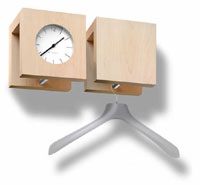 From Lapalma Design comes the clock/coat hanger. Available in natural maple or stained cherrywood.
The clock dial is white lacquered with quartz movement.
Designers: Shin and Tomoko Azumi
Link: Lapalma
Who wouldn't like to be Mr. Gehry's neighbor?
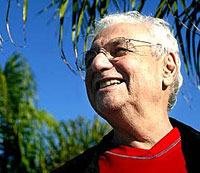 Mr. Gehry finds peace with his new Venice neighbors.
It started as a rumor, hardly louder than the rustle of palm fronds from the octet of 90-foot trees that sway above the southern end of one green, quiet block. Frank Gehry, for most people's money the most famous architect in the world, had bought the large vacant lot at the northern end of the block. He was planning to build his dream house there.
Perhaps the very first thought — you could see it in people's dawning reaction, even from those who haven't yet rattled their jewelry at the much-debated Walt Disney Concert Hall downtown — was that the house had every chance of looking as wrong as Shaquille O'Neal in a Miami Heat uniform. But that thought was almost immediately shooed away by a second: They were about to be … Gehry-adjacent.
From the LA Times.
Link: LA Times
Lunchbox for grown-ups
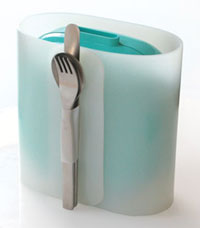 Unique package combining a plate, bowl, cup, utensils, and placemat.
"A personal plate, bowl, cup, and utensils, all snugly wrapped together in a desktop-sized placemat. This set of dishes expands your good-design sense to the office and stands with upright readiness next to a desk or in the communal kitchen cupboard. Made of high-heat malamine, the dishes add a touch of practical elegance to our takeout soup and sandwich."
Link: Vessel-Store
Business signage from Square One design
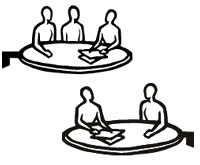 Distinctive business signage from this Michigan-based design firm.
"Need the bathroom? Gotta check your voicemail? Time for a caffeine fix, pronto? Life's minor emergencies call for signage that speaks loud and clear, in any language. Out of the ordinary yet obvious, our highly visible 3-D signage brings a sense of order to your work environment, all with a creative spin and whimsical touch. Our icon based signs are made of flame retardent, high-density black PVC. Installation is accomplished lickety-split, thanks to brushed aluminum brackets that require just two screws."
Link: Wheresthebathroom.com
Link: Square One Design
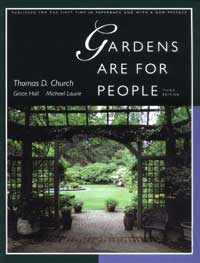 A must read for anyone interested in modern landscape design... we here at Land+Living borrow liberally from Church's philosophy.
 This text contains the essence of Thomas Church's design philosophy, as well as practical advice. It is illustrated by site plans and photographs of some of the 2000 gardens that Church designed during his career. Called "the last great traditional designer and the first great modern designer", Church was one of the central figures in the development of the modern Californian garden. For the first time, West Coast designers based their work not on imitation of East Coast traditions, but on climatic, landscape and lifestyle characteristics unique to California and the West. Church viewed the garden as a logical extension of the house, with one extending naturally into the other.
Author: Thomas D. Church
Link: Amazon