An early American Modernist landscape
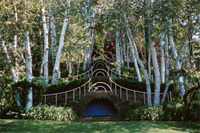 John Fletcher Steele was a one of the first American Modernists of landscape architecture. In 1907 Steele attended Harvard's Graduate School of Landscape Architecture where he was taught by none other than Frederick Law Olmstead Jr. in the Beaux Arts tradition, but later became greatly influenced by the French Modernist of his time; the Vera brothers and Gabriel Guevrekian in particular.
While his style in his professional practice remained relatively rooted in Beaux Arts principles, his writings and exhibition work showcased his Modern gleanings. During his career, Steele made a friend out of heiress Mabel Choate, daughter of Joseph Choate the prominent New York attorney, who's love of travel fed Steele's creativity and together they conspired to create his signature gardens at Naumkeag in Stockbridge, Massachusetts.
Link: Naumkeag Trustees
Link: Naumkeag Projects
Via: Garden Visit
Reference: Modern Landscape Architecture - A Critical Review (L+L)
A naked eye observatory outside of Santa Fe, New Mexico
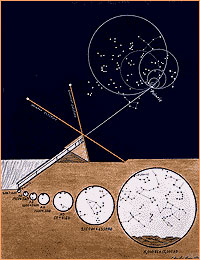 Last December we were inspired by an article in The Guardian to make a post about various earthworks including Star Axis by Charles Ross. And we ran across a nice piece on Star Axis posted today by BLDGBLOG. After poking around a bit more, we found several good links regarding Star Axis for your browsing pleasure.
Charles Ross conceived of Star Axis in 1971, and the Chupinas Mesa site in New Mexico was obtained in 1975.
Star Axis is an architectonic earth/star sculpture constructed with the geometry of the stars; earth-to-star alignments built to human scale. It offers an intimate experience of how the earth's environment extends into the space of the stars.
Link: Star Axis
Coords: N35°15.862, W105°05.217 (13E 492090 3902362N) [via]
Via: BLDGBLOG - Roadhenge
More links:
Link: Eyestorm - Charles Ross Star Axis
Link: Exploratorium - Light and Landscape (Real and Quicktime movies)
Link: Collector's Guide - Star Axis – A Theatre in the Sky
Reference: Earthworks revealed (L+L)
Reference: Satell(s)iteseeing (L+L)
Rediscovered 11 years ago, one of the world's oldest and rarest trees on display
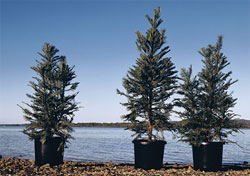 A public exhibition at the Royal Botanic Gardens, Sydney, is currently running through October 22, and will culminate in an international Sotheby's auction of the Collectors Edition trees on October 23, 2005.
The installation at Sydney's Royal Botanic Gardens will replicate the secret grove where the Pines were first discovered.The auction will feature fewer than 300 first generation Pines grown from cuttings taken from the wild population. Each Collectors Edition tree can be traced back to its parent tree in the wild. Proceeds will benefit conservation efforts of the Wollemi Pine and other rare species. In addition, six groves of five trees each will be dedicated to conservation organizations in Australia, New Zealand, the UK, Germany and Japan.
The general release of smaller Wollemi Pine pot plants will take place internationally in April 2006.
Wollemi Pine International
When Maurice Calka went plastic
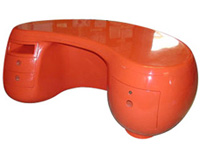 In 1969, the renowned French sculptor Maurice Calka issued something different: the Boomerang desk. A sexy molded fiberglass and plastic desk. The largest version, the PDG, came with a matching molded chair and personalized control panel was enough to impress President Pompidou who owned one in white and placed it in the Elysée Palace; the contrasting Baroque and 70's plastic fantastic raised a few eyebrows back then. Manufactured by Leleu-Deshays they are highly sought after, but only 35 were produced as a limited edition piece. Recently, a Boomerang desk came up for auction and was sold for 29,300 Euro (roughly 35,000 USD).
Link: Maurice Calka
Via: A.D.
W.S. Tyler Wire Cloth for Architecture and Design
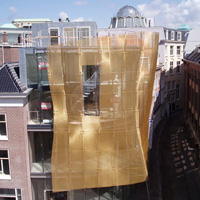 Facade, screen, ceiling, shelter, sound and fire barrier are just some the things that the architectural wire cloth series from Haver & Böecker can be. A thoroughly versatile steel mesh, it can take on harsh weather and pollution, and is often used along highways and in industry as a filter. The aesthetic qualities of architectural wire cloth make it ideal as a skin allowing subtle changes of colour and light at different angles. It also offers a myriad of options for interior application as ceilings and screens. Haver & Böecker have been producing woven wire cloth since 1887 with their first operation in Hohenlimburg, Germany and are distributed worldwide by their parent company W.S. Tyler.
Link: W.S. Tyler
Link: Haver & Böecker
A massive urban sculpture envisaged by Isamu Noguchi
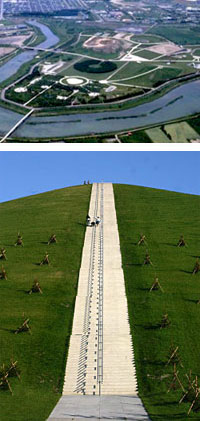 Seventeen years after Isamu Noguchi's death, his last work has been realized in the northeastern part of Sapporo as part of the city's annular greenbelt. Moerenuma Park was sculpted out of a 198 hectare waste disposal site which Noguchi specifically selected during his visit in March 1988. Noguchi completed the master plan of the park before his death later in 1988.
Noguchi believed that art and sculpture should be useful. His proposals for large-scale sculptures in the public realm date back to the 1930's, and he was especially drawn to the notion of play sculpture, though only one of his playgrounds was completed during his lifetime. Many of Noguchi's unrealized concepts were integrated into the design for Moerenuma.
The park was completed in July of 2005 under the guidance of the Isamu Noguchi Foundation, architects Shoji Sadao and Junichi Kawamura (longtime Noguchi collaborators), Kitaba Landscape Planning, Park Director Hitoshi Yamamoto and city officials.
Link: Moerenuma Park (Japanese)
Link: Green City Sapporo (Japanese)
Link: Sapporo City - Moerenuma Park and Isamu Noguchi
Link: Isamu Noguchi Garden Museum Japan
Article: Japan Times - Filling an emptiness with public play
Article: Asahi Shimbun - Ingenious Vision/Moerenuma a sculpture that doubles as playground
Related: California Scenario (L+L)
Related: The Isamu Noguchi Garden Museum (L+L)
Water-retentive paving blocks
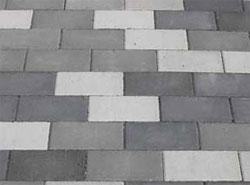 It looks like your run-of-the-mill paving block, the same kind you can pick up at your local home improvement store. But these "Eco-Pavers" manufactured by Matsuo Corp. of Ibaraki, Japan can actually retain water and, used en-mass, greatly reduce the heat island effect of large areas of paving.
Made of recycled construction materials, Eco-Pavers are specially cast to wick up water through capillary action. The pavers actually mimic plant transpiration to provide natural cooling; surface temperatures of the blocks can be lower than the air temperature by 2° - 3° C (3.5° - 5.5° F) and lower than the surface temperature of ordinary blocks by 10° C (18° F) or more.
Link: Matsuo Corp (Japanese)
Article: Daily Yomiuri
Via: Treehugger - Matsuo Corp's "Eco-Paver", Water Retentive Blocks
Exhibition on the work of Barragan shows his vision for blending architecture with nature
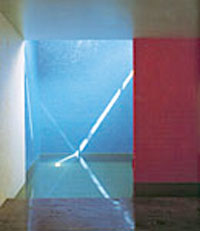 An Exhibition on the work of the Pritzker Prize winning architect Luis Barragan is now showing through November 6, 2005 in Athens, Greece at the Benaki Museum in the Pireaus Street Annexe.
The exhibition presents approximately 70 large-scale photographs by Japanese architect Yutaka Saito, wooden models (approximately 1.0-1.5 sq.m. apiece), as well as a series of the corresponding designs (floor plans - designs) of works by Barragan. In tandem with the exhibition, there is a video installation, with a 15-minute film on the forms of the Barragan oeuvre.
Link: Benkai Museum
Article: Kathimerini
Photography exhibition
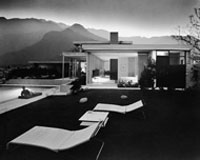 The Getty Research Institute has acquired the complete photography archive of Julius Shulman and will be exhibiting some of the collection in the Research Institute Exhibition Gallery at the Getty Center in Los Angeles. Opening today and running through January 22, 2006.
This exhibition will confirm Julius Shulman's place as one of the 20th century's most influential visual historians of modern architecture and the Los Angeles region. Shulman is world renowned for creating iconic images of Richard Neutra's Kaufmann House (1947) in Palm Springs and Pierre Koenig's Case Study House (1960) in the Hollywood Hills.
Exhibit: Julius Shulman, Modernity and the Metropolis
Link: Getty Research Library - Julius Shulman Resources
Planar landscape phenomena
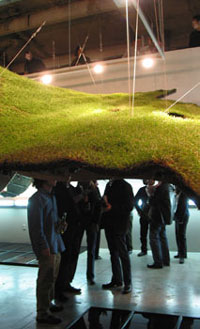 This installation by Griffin Enright Architects featured at SCI-Arc (12/03 - 2/04) consisted of over 1,000 square feet of sod laid on an hovering armature.
The concept resonates with me on a variety of levels, not the least of which is that it reminds me of a project by Nicolas and me from SCI-Arc where we created a warped landscape plane called the "Berm-Bender" which was lifted and sliced to create openings to the parking structure below... hmmmm... were they on that jury, Nico? ;-)
The ubiquitous lawn is the subject of a heuristic exercise about our cultural relationship to that thin plane of suburban carpet... exploring the tectonic nature of this plane by emphasizing its tissue-like thinness, flexibility, and texture, while commenting on its negative impacts on our larger environment.
Link: Griffin Enright Architects
Link: SCI-Arc
Giant Bucket Wheel Excavators: the next generation
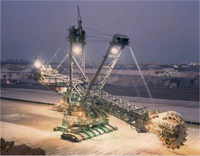 If you're a civil engineer this picture is probably on your desktop, but for the rest of us the Giant Bucket Wheel Excavator from ThyssenKrupp Fördertechnik is enough to make us rub our eyes in disbelief. The Giant Bucket Wheel Excavator is the largest of it's kind used for mining. The mining capacity of giant excavators makes them desirable despite the cost and length of time needed to build and transport them.
It takes 5 years to put a Giant Bucket Wheel Excavator together, so taking it apart when it needs to change sites is out of the question. Instead, it is driven to the next site traveling at approximately 1 mile every 3 hours, and everything in its path i.e. telephone wires, needs to be removed or risk being destroyed. Again, the production rates justify the coordinated efforts needed for its transportation.
Link: ThyssenKrupp Fördertechnik
Parks, landscape, water, urban design...
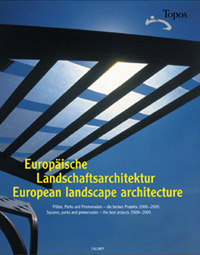 European Landscape Architecture is the latest Topos publication representing the best in open-space architecture including parks and squares, waterfront promenades and memorials across Europe.
All of the projects featured were completed between 2000 and 2005, making it an extremely relevant resource for professionals and students. The entries included in European Landscape Architecure were chosen from the Topos special edition International Review of Landscape Architecture and Urban Design. The book highlights work from a broad range of landscape architects, providing a good cross-section from both well-known and lesser-known firms.
Link: Topos
British Columbian modernism
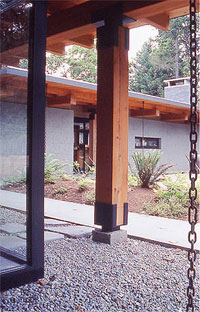 The work of Vancouver based D'Arcy Jones Design is modern yet warm, simple yet intricately detailed. There is that sensibility and materiality associated with contemporary American North-Western design as exemplified by architects such as James Cutler and Miller Hull, yet with a spatiality and form reminiscent of Rudolph Schindler, Richard Neutra and Ray Kappe.
While their built work has been primarily residential homes, the firm designs buildings of any type and scope and has designed a product line of furniture and hardware introduced in 2004. Their designs integrate with the natural and built landscape with skillful attention to detail.
Link: D'Arcy Jones Design Inc
Via: Architechnophilia
Understanding the desire for meaningful design
 Is it like me? Does it like me? Can it make me more? These are the questions that are at the heart of Ravi K. Sawhney's (Ph. D., President & CEO, RKS Design Inc.) theory of Psycho-aesthetics® that looks to bring deeper meaning to product design. The basic principle stems from a desire to express a product's function through its design, coupled with the need to understand how we engage stimuli. Using precedent, Sawhney takes Maslow's Hierarchy of Needs and the parable of the Hero's Journey, and creates a model for design that addresses innate core desires, the goal of which is ultimately fulfillment.
Simply put, Psycho-Aesthetics is not about the best design – it’s about meaningful design. Taken a step further, it’s not about the design at all – it’s about our undeniable need for positive affirmation and how we fulfill this need.
Link: RKS Psycho-Aesthetics®
Link: The Psycho-Aesthetics Martini (pdf)
In-situ soil analysis
 Brownfield reclamation is on the rise, and soil analysis and remediation is becoming an art form of its own. The ability to analyze soil in-situ means considerable time and cost savings, and Niton's new XRF Analyzer series is designed to do just that. Armed with the technology to analyse soils for levels of lead, lead paint and heavy metals, it is a valuable tool that happens to be extremely portable at only 3lbs. It also has the added option of being fitted with Bluetooth wireless connection. Niton was recently awarded the IDEA (Industrial Design Excellence Award) Gold medal award for its XRF Analyzer family.
Link: Niton XRF Analyzer
Link: IDEA Awards
Midcentury and Danish Modern furniture seller
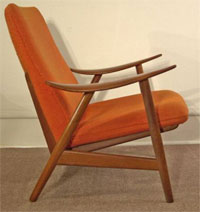 Do you eBay?
If so, check out the vintage mid-century and danish modern offerings listed by Kollection. Based in Chicago (and St. Louis), they offer many of their peices for sale online under the eBay seller name yramtac71.
Link: Kollektion
Via: Design*Sponge
Three firms selected as finalists for the former El Toro Marine
Corps Air Station
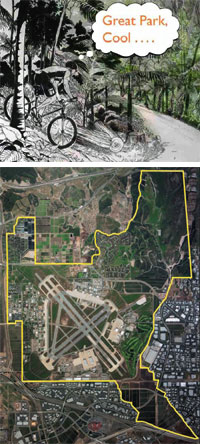 The field of seven firms selected from the original thirty-eight has now been narrowed to three finalists for the design of what would be one of California's largest urban parks. The finalists are EMBT from Barcelona, Spain, Royston Hanamoto Alley & Abey from Mill Valley, California, and Ken Smith Landscape Architect from New York, New York.
Closed in 1999, El Toro was originally slated to be the site for a new international airport. After voters killed the highly contentious airport proposal in favor of parkland, the City of Irvine spearheaded the effort to create "one of the finest metropolitan parks in America."
The Navy recently sold the property to Miami based Lennar Communities who will develop 10% of the seven square mile property and contribute money towards the development and maintenance of the Great Park.
Larry Agran, Chair of the Orange County Great Park Corporation:
Fredrick Law Olmstead designed New York’s Central Park in the mid 19th Century and inspired the creation of great metropolitan parks throughout the United States. We are conducting an international search for the Fredrick Law Olmstead of the 21st Century, and are confident that we will find a designer of his caliber for the Great Park.
Link: Orange County Great Park
Link: EMBT Arquitectes Presentation (pdf)
Link: Ken Smith Presentation Doc 1 Doc 2 (pdf)
Link: RHAA Presentation (pdf)
Link: Video of public presentations
Via: Archinect
A modern rammed earth house rooted in rural Australian vernacular
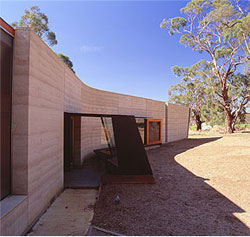 Designed by Melbourne-based John Wardle Architects, this house is located on the Mornington Peninsula outside of Melbourne.
Designed as an exploration between the site and the lives of the owners, the house embraces the site and surrounding landscape. Built primarily of rammed earth with elements of timber framing and steelwork, the elements recall Australian rural vernacular structures. While the design is decidedly modern, there is an almost arts and crafts attention to detailing and use of material.
Firm: John Wardle Architects (Site not Firefox friendly)
Article: Architecture Australia - July/August 2004 - Grafts and Crafts
Via: Earth Architecture
Bonded Logic harnesses the warmth of denim
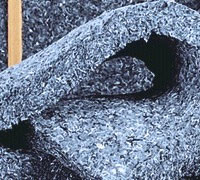 You might not think of denim as a suitable building material, but its rugged fibers have been the choice of labourers since the 16th century given that its durable, comfortable and warm. Bonded Logic recognized denim's primary benefits and used it to create a sustainable and effective insulation.
UltraTouch is a natural cotton-based fiber insulation made from 85% post-industrial recycled fibers that harnesses the warmth and woven density of denim. It does not emit VOCs and is resistant to fungi. It also meets the highest ASTM testing standards, and contains no chemical irritants. Furthermore, UltraTouch's unique manufacturing process creates a three dimensional infrastructure that traps, isolates and controls sound waves reducing sound from traffic, airplanes, radios, television, and conversation.
Link: UltraTouch
An Exhibit of seventeen original landscapes
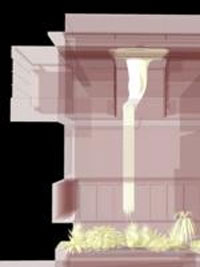 This exhibition for gardens designed to be part of the proposed 3rd floor addition to USC's architecture building is now showing at USC Verle L. Annis Architecture Gallery in Harris Hall through Saturday, October 1, 2005.
The School of Architecture's 21,000 square foot 3rd floor expansion of Watt Hall will house the School's four graduate programs. Alternating gardens and office spaces will form a ten-foot perimeter around the building. Each of the 17 gardens will be an original landscape design by an internationally renowned landscape architect. With the use of drought-tolerant and sustainable plants, the gardens will serve as a valuable tool for landscape studies and will act as the lungs for the building - allowing air to flow through the office, studio and gallery spaces.
Link: USC - Visions of Sky Gardens
Limited edition rugs designed by Akira Isogawa
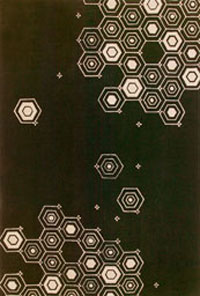 Australian fashion designer Akira Isogawa has designed a limited edition collection of rugs with bold graphic patterns with a decidedly Eastern influence.
The rugs are hand-knotted cut and loop pile of 100% New Zeland Wool or New Zealand Wool & Viscose. Naturally, the rugs come with a designer price tag starting at $4990 Australian (approx. $3,800 US).
Link: Designer Rugs - Akira Range
Designer: Akira Isogawa
Via: The Age - Rugging up
Building On An Elevated Surface
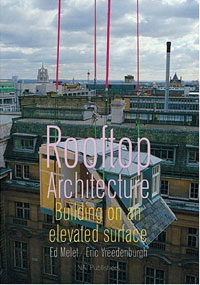 Excerpted from the publisher:
The land in big cities has be used more intensively, but the possibilities are limited. One of the leading options for the future is the use of the flat roofs of residential buildings and office blocks as a building site.
This book analyses and describes the opportunities for realizing projects of this kind, as well as the potential difficulties, using interesting examples of construction on top of existing buildings in the Netherlands and abroad. It will therefore be influential in establishing a benchmark for architecture and urban planning that is a necessity if rooftop architecture is to have a serious future.
Editor: Eric Vreedenburgh
Link: NAi Publishers
Link: Amazon
Via: Things
Related:
Up on the rooftop (L+L)
Simplicity x function = popularity
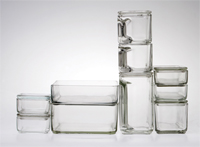 A funny thing happened while browsing though the many aisles of Hot Property, a mecca for things Modern in the city of Toronto, I spied some glass containers that were in a locked cabinet. I have been on the hunt for glass containers, with plastic getting so much bad press these days, and inquired as to their price. The shop-keep told me that while he wasn't sure of their exact price, they were in fact "thousands, and thousands of dollars". It turns out that they were original Wilhelm Wagenfeld Kubus stacking containers from ca. 1935.
Wagenfeld studied at the Bauhaus school and produced these simple containers after he left. They were manufactured as sets of seven, with interchangeable lids that were meant to be used as both storing and serving pieces. In true Bauhaus style serial repetition and function led to their extreme popularity, hence the myriad of replicas available on the market today.
Link: Metropolitan Museum
Contemporary reinterpretations of treehouses
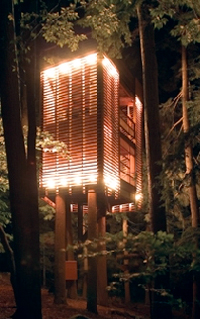 Treehouses have grown-up and are winning awards for excellence in design and innovation. If the idea of treehouse as family dwelling conjures up images of the Swiss Family Robinson, then prepare yourself for the following reinterpretations.
In 2003 Lukasz Kos, a masters student at the University of Toronto's School of Architecture & Design, took honourable mention at the OAA awards for his Muskoka, ON. treehouse, an elegant slatted structure that scales the trees and lets light radiate down it's core.
More recently, Joel Sherman of jls Design produced his AIA award-winning Steel Tree House in Lake Tahoe, CA, a sprawling residence that is cleverly engineered to work with snow loads and sloping terrain. Then there is Marcio Kogan's BR House in Araras, RJ that was built up to the canopy, and allows trees to puncture through the roof at points creating a contemporary elevated living space.
Link: Lukasz Kos
Link: Marcio Kogan
Via: Nelson Kon fotografias
Link: jls Design
Via: Dexigner
Tinted particleboard and fiberboard interior finish panels
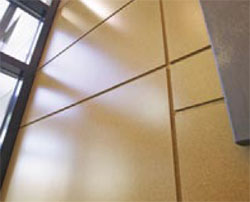 Made by Columbia Forest Products, these eco-friendly composite panels are suitable for cabinetry, furniture, tabletops and wall paneling.
There are two products in the line, each with their own aesthetic textural qualities: either FSC-certified M3-grade particleboard or WOODSTALK® wheat straw agrifiber panels. There is
no added formaldehyde and the panels are finished with a durable, zero-emissions UV cured acrylic finish.
The material has been used by architect
Todd Saunders for the design of the BlueSkyMod prefabricated housing unit recently written up in The Globe and Mail.
Link: Columbia Forest Products
(The product is not listed on website, but they still make it
Link: EcoColors Brochure (pdf)
Via: Treehugger
Le Corbusier series of DVDs now available
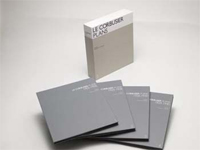 Can't get enough Corbusier? The Fondation Le Corbusier and Codex Images International - Birkhäuser are offering a series of DVDs that chronicle the work of Le Corbusier from 1905-1964. Broken into series of 4 sets, October heralds the arrival of the second set of 5 DVDs covering the years 1930-1945. The complete set features roughly 300 projects that will no doubt serve as an important archive for researchers, students and enthusiasts.
Each project is accompanied by expert commentary and fully printable images. Fortunately for us they were not shy about including shreds of plans either. Series one: 1905-1930, a 4 DVD set, is currently available, but at the rather steep price of € 1600 or € 5800 for the series (approximately $1300 and $7000 US), it's probably best to harass your local library or university into making the purchase.
Link: Order Form
Link: Codex Images (Japanese/English Site)
Link: Fondation Le Corbusier
Via: arcspace
Face-to-face lounging for two
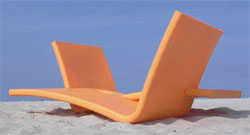 Architect and designer, Michael Hilgers, created the dialounge as part of an exclusive collection for the label rephorm. The dialounge is available in orange, olive, and cream and features cupholders along with a place for your magazines.
"The communication- chaiselongue dialounge is manufactured in PE in the rotational-moulding process. It is wheatherproof, can be dismantled, is stackable and has integrated cupholders as well as space for magazines.
for Club, Lounge, Pool, Hotel, Garden, Bar, Patio, Beach, Livingroom...."
Link: dialounge [Thanks, Michael!]
The exhibition of architecture through the form of the pavillion
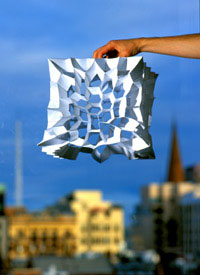 This exhibition presented across two venues at Monash University near Melbourne: the Monash University Museum of Art on the Clayton campus and Faculty Gallery on the Caulfield campus. The show opened September 7th and runs through October 29, 2005.
Pavilions for New Architecture presents the creative practices of a dynamic group of contemporary architects who have emerged on the architectural scene over the past decade.
Taking the pavilion as its subject, and as a lens through which to view the practice of architecture, Pavilions for New Architecture offers a significant opportunity for the open expression of architecture at a scale that is at once playful and provocative, speculative and rhetorical.
Link: Monash University Museum of Art - Pavillions for New Architecture
Review: The Age
Proving that contemporary handcrafted furniture is not oxymoronic
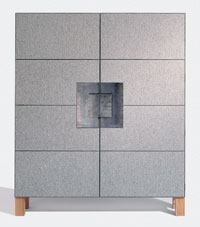 If you are looking for a handcrafted piece of furniture with high aesthetic value, and the kind of substance that will take 4 people an hour to haul up a staircase, then the Lambert company is for you. With it's head office in Mönchengladbach Germany, the Lambert company trains it's craftspeople to reproduce their unique designs in various locations around the world, and herald themselves as the custodians of traditional arts and crafts. They stress the use of natural materials, dowels and wax finishes, but yet have a penchant for clean lines and little to no embellishments leaving their pieces looking thoroughly contemporary. While there may be variations in what is available from distributors, what is constant is the high quality and design of each piece. Gunther Lambert will no doubt be highly desired as collectibles in the decades to come.
Link: Lambert
The GreenSpec® Guide to Residential Building Materials
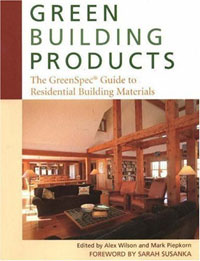 From the publisher:
Here's a comprehensive directory of green building products for home building and remodeling featuring more than 1,400 descriptive listings for products from ag-fiber panels to zero-VOC paints. All phases of residential construction are covered, from sitework to flooring to renewable energy. Products are grouped by function, and each chapter begins with a discussion of key environmental considerations and what to look for in a green product.
Editors: Alex Wilson and Mark Piepkorn
Link: Green Building Products (BuildingGreen)