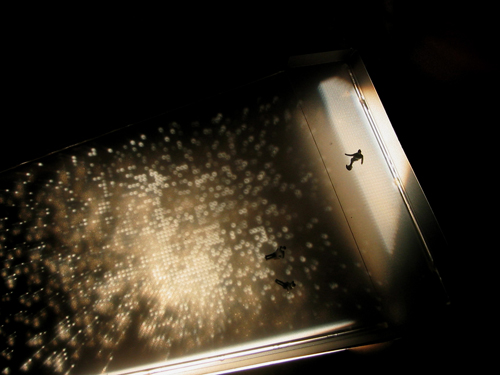

Designing for the 24-hour environment
 Designing for the 24-hour environment requires that the designer have an understanding of the materials that can be used to illuminate spaces shadowed by darkness. Convention points us towards traditional forms of lighting like halogen, solar, LED etc... but what of the luminescent properties of the materials themselves? Properties that include: transparency, reflectivity, retro-reflectivity, photo-luminescence, thermo-luminescence, screening, fiber-optical luminescence and fluorescence? This was the focus of a project lead by Pierre Bélanger, Assistant Professor Faculty of Architecture, Landscape & Design, University of Toronto that used night as the point of departure for a rooftop landscape architecture plan.
Link: AL&D
Students were given a luminescent material to study and employ in the construction of the final built model. During the material investigation stage, students had to regularly showcase photographs of their studies which had not been digitally altered, but yet they were not obligated to reveal the methods used to obtain the image. By placing constraints on the project, a greater understanding of photography and model making were gained, as well as the potential for using luminescent materials in the built environment.
Melissa Mckay & Jessica Hutcheon

Deborah Kenley & Grace Tang

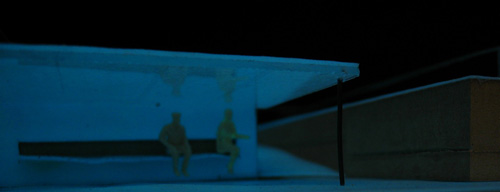
Gabriel Spence


Van Thi Diep & Cherie Xiao