Spanish born garden designer Fernando Gonzalez is the principle and founder of Metagardens, a gardens design firm based in London. Fernando says that “the boundaries between the artificial and the organic are more blurred than ever before” and his innovative design practice seeks to address these challenges of the digital age through both built and experimental projects. Through computational techniques and an exploratory approach to design it proposes to go beyond the ordinary and conventional.
We live in a post-human environment where the relationship between the biological and the machine is more of a symbiosis than of contradiction. Our cybernetic culture sees Nature as something manufactured far away from ‘naturalistic’ theories that dream with a romantic and uncontaminated environment outside of our culture or, even worse, as a return to the past. But while the rest of the artistic disciplines are mutating to adapt to the new challenges garden design practices and theories are still based in outdated ideas incapable of dealing with the complexity of the new situation.
I really like the simple and familiar forms of this outdoor furniture suite designed by Peter Brandt for Swedish furniture maker Nola. The design is basic and almost utilitarian somewhat recalling national park furniture, but with gracious proportions and details.
The line features an armchair, a round table, a rectangular table, a bench, a bench with backrest, and a bench with backrest and arms. The pieces are made of either pine finished with alkyd oil enamel or oak finished with oil.
Being a web publication, I suppose we're a bit jaded when it comes to seeing Land+Living listed on another website... like earlier this week when we were listed among A Web Design Dozen in Newsweek's design feature. Admittedly cool, but we just don't have time to jump up and down every time we see our name on the web.
But there is something about seeing your name in print... there it was today when I opened up the latest hard copy issue of Newsweek (the one with Johnny Depp right on the cover) to the Design 2006 spread.
When it comes to print, there is only so much space... so we were thrilled to be listed as one of only six websites that Newsweek chose for its print edition... right up top no less! With a screen shot! Good thing we got decked out in our new duds first... mom will be so proud.
Congrats to our compadres who were also splashed with some ink:
A social oasis in the urban environment... she's electric
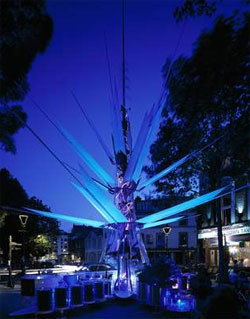
Nothing to do with the UK national treasure... the London Oasis is a temporary structure on Clerkenwell Green installed as part of national Architecture Week. It is a kinetic sculpture by architect Laurie Chetwood designed to demonstrate sustainability and renewable energy while providing entertainment, a place for meeting and tranquil space for Londoners. Self-sufficiently powered by solar cells, a hydrogen fuel cell and wind, the Oasis interacts with the environment around it. Shade providing "branches" open and close in response to the weather. Enclosed pods at the base provide a place of seclusion for people to rest with "cleaner cooled air and relaxing sounds." At night the Oasis acts as a beacon in the cityscape with lights which repsond to the movements of people around it. It even uses rainwater it has collected for irrigation and cooling.
Australia’s leading exhibition for emerging designers
The free exhibition launches on 8 August at Sydney’s iconic Chifley Plaza and runs 9-19 August 2006. WORKSHOPPED differs from any other design showcase held in Australia because its main purpose is to foster promising talent and turn their ideas into a commercial reality; ready for the world stage. The exhibition will feature a range of design principles and materials including furniture, lighting, screens, installations and graphic design.
Here is an interesting way to look at the underlying code structure of a website. German blogger Ahref has written an app that graphically charts the hierarchy of a website's HTML tags. Shown on his site are graphs of many well known websites such as Google, CNN, Apple, etc.... pretty cool.
A sketch competition for duilding designs in dramatic locations
This competition (sponsored by Building Design, SketchUp, et al.) "offers you the opportunity to stretch your creative mind to the full. The buildings, of course, are not going to be built - the aim is to see what you think is possible..." This is a sketch competition - not developed designs - and is open to architects, architectural technicians, students, designers and engineers.
The three sites are: the base of Mount Everest, the Niger desert, and the River Thames estuary. The three briefs will become available for download in different periods.
San Francisco Bay Area painter Laura Elisabeth Bauer creates abstract art works exploring nonobjective constructivism on canvas and sculptural forms. She counts modern masters Matisse, Miro, Mondrian, and Picasso among her influences as well as the period from 1920 through the 1950's, especially the abstract female artists Popova, Hepworth, and Hartigan.
There is a frenetic energy to her work which, to me, seems to speak of the modern world and urban/suburban landscapes which we inhabit. Yet there is a calm grounded quality and connection to the past residing in the layered complexity of her work.
She says:
I am learning that there are many ways of expressing creativity, and I remain open to continue in my exploration into the unknown. I not only enjoy looking to the past for inspiration but I also enjoy revisiting my old work and taking it a step further, using the old and integrating it with the new.
Department of design culture edited by Adriean Koleric
We're amping it up L+L a bit here with a slight update to our look and feel, and the addition of a new Branch to expand our offerings.
Edmonton, Alberta based designer Adriean Koleric has been a contributor at Land+Living for some time now - and we are pleased today to announce that DesignBOT, Adriean's design blog, has joined the Land+Living network! DesignBOT will bring turn up the funk on L+L and expand our horizons with more design lifestyle, pop culture and fashion focused content.
The Smithsonian’s Cooper-Hewitt, National Design has announced the winners of the seventh annual National Design Awards. The finalists and winners will be honored at an event on October 18, 2006.
"Cooper-Hewitt is delighted to once again recognize, through the National Design Awards, some of the greatest contributions to the world of design made in recent years." Cooper-Hewitt director Paul Warwick Thompson said. "Each year, the Awards grow in scope, and this October we are introducing National Design Week, a new education initiative created to promote better understanding of the role that design plays in all aspects of our lives. During National Design Week, Cooper-Hewitt will host programs and panel discussions on design, and on our website, we will launch design education content for teachers nationwide."
An exhibition at the Barbican Art Gallery in London running June 15, 2006 - September 17, 2006.
From extraordinary houses and incredible towers, to fantasy cityscapes and inhabitable sculptures, Future City showcases the most radical and experimental architecture to have emerged in the past 50 years.
From the visionary artist-turned-architect Constant Nieuwenhuys, to 1960’s giants Archigram and SuperStudio, to deconstructivists Daniel Libeskind and Zaha Hadid and contemporary digitally inspired work by Nox and Decoi, this is the most comprehensive survey of experimental architecture to be held in the UK.
Royal Architectural Institute of Canada honors 12 projects
The Royal Architectural Institute of Canada (RAIC) and the Canada Council for the Arts have announced the winners of the Governor General's Medals in Architecture for 2006.
The Governor General's Medals in Architecture recognize outstanding achievement in recently built projects by Canadian architects.
The honored design teams are:
Les architectes FABG
atelier TAG, Jodoin Lamarre Pratte et Associés Architectes (2 projects)
Baird Sampson Neuert Architects
Lapointe Magne + Ædifica
Atelier in situ
Florian Maurer Architect, MRAIC
Smith Carter Architects and Engineers Incorporated
Brave Space's flat pack version of their block-game shelves
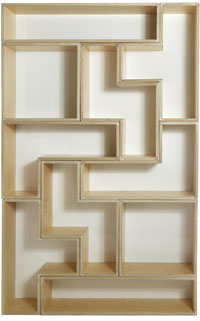
Nearly two years ago we were inundated with traffic after featuring the work of Brave Space Design. Specifically, it was their Tetris shelving that ignited the firestorm... people were like, freaking out. Totally.
So we're bracing ourselves this time, because the Brooklyn-based design trio has introduced a pack flat version of the block-game inspired shelves: Tetris Flat.
The modular system features wooden sides with metal backing and assembles "in minutes." The frames are available in white or natural wood with multiple color options for the backing. The units are sold block by block for $120 each to create a custom configuration.
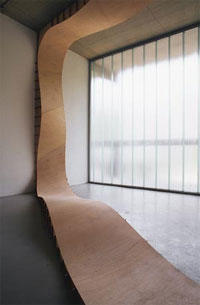
London based artist Joanna Sands bridges the realms of art and architecture by creating contextual sculptures which challenge and inform the perception of space. She began making large temporary sculptural installations in abandoned buildings in 1993, often using found materials. The use of dilapidated structures as a canvas brings to mind the work of Gordon Matta-Clark - the appropriation and investigation of cast off places. By making visually simple alterations to found spaces, Joanna subverts the spatial expectations of the viewer. These early pieces were ephemeral: constructed, documented, experienced as the venue for a "viewing" party, and then dismantled.
More recently, Sands has begun to undertake commissions for permanent installations and has displayed some of the research models developed in the course of designing her site-specific work. The piece shown at right is located in Joanna's own studio.
Sands' work will be on exhibition 20th May to 10th June at the Optician Gallery in London.
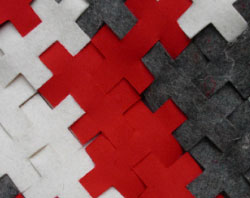
San-Francisco-based designer Galya Rosenfeld has created a system that uses fabric scraps which can be attached and configured without glue, stitching, buttons, etc. to create a wide variety of objects. One of her creations from this ingenious system are Modular Pillows. The beauty of the system is that there are practically infinite configurations of colors and forms - damaged pieces can be replaced and the entire object can be disassembled and recycled.
Galya will be featured at HauteGREEN later this month.
The American Society of Landscape Architects (ASLA) has announced the recipients of its 2006 Professional Awards. The jury considered over 500 entries and selected 32 projects to receive awards. The awards will be presented on October 9 at the ASLA Annual Meeting in Minneapolis.
The top "Awards of Excellence" are awarded in several categories:
The General Design Category winners are Michael Van Valkenburgh Associates (From Brownfield to Greenfield: A New Working Landscape for Wellesley College Wrenched from its Toxic Past) and Landworks Studio, Inc. (Court Square Press Courtyard).
The Residential Design Category Award of Excellence is awarded to Steve Martino & Associates (Quartz Mountain Residence).
The Analysis and Planning Category Award of Excellence winner is Sasaki Associates, Inc. (Providence 2020 Plan, Providence).
The Communications Category Award of Excellence is awarded to Peter Walker and Partners (Land Forum Magazine).
Top ten examples of sustainable architecture in the U.S.
The American Institute of Architects (AIA) and its Committee on the Environment (COTE) have selected the top ten examples of sustainable architecture and green design solutions that protect and enhance the environment. The projects will be honored on May 3 during a presentation at the National Building Museum in Washington and again in June at the AIA 2006 National Convention and Design Exposition in Los Angeles.
The 2006 COTE Top Ten Green Projects address environmental conservation and the notion of sustainable development with designs that integrate architecture, technology, and natural systems. They make a positive contribution to their community, improve comfort for building occupants, and reduce environmental impacts through strategies such as: reuse of existing structures, connection to transit systems, low-impact site development, energy and water conservation, use of sustainable or renewable construction materials, and design that improves indoor air quality.
An open competition to design a chair, sofa or stool that reflects our time
Even though the function of a chair as an aid to sitting has not really changed over time, its design has evolved in parallel to society. It has reflected the developments in technology, architecture, and industrial design. Furthermore, chairs have been a social, aesthetic, and symbolic statement. Chair design has been a declaration of attitudes, ideas, and viewpoints.
During the XX Century there were some chair designs that succeeded to reflect the society of their time. Some of the best known examples are Charles and Ray Eames' molded plywood chairs, Alvar Alto's No. 41 Chair or Marcel Breuer's B3 Chair. Their highly innovative designs responded both to ergonomics and manufacture processes.
As our society has changed we are looking for a chair design that succeeds in communicating the XXI Century personality.
This is an open competition to design a chair, sofa, or stool that reflects our time.
My chair is a reflection on style, trend, attitude, and culture.
There is nothing more glamorous for an architect than designing America's malls... except perhaps designing 13,000 square foot faux-Tuscan additions to 9,000 square foot even-more-faux-Tuscan houses... ahem.
This project in Anaheim, California, has been in the proposal stage for years, and it appears that it is finally going to move forward. Situated right across the street from Disneyland, the architects absolutely had to out do themselves... and indeed they have turned architecture on its head. Don't believe me? Let's take a closer look just for shits and giggles...
Link: GardenWalk
Via: Curbed (LA style) - Anaheim Approves New Tourist Trap
Paulo Mendes da Rocha of Brazil was announced today as the winner of the 2006 Pritzker Prize winner. The 77-year old architect is Brazil's second Pritzker laureate joining Oscar Niemeyer who was honored in 1988.
In announcing the jury’s choice, Thomas J. Pritzker, president of The Hyatt Foundation, said:
Mendes da Rocha has shown a deep understanding of space and scale through the great variety of buildings he has designed, from private residences, housing complexes, a church, museums and sports stadia to urban plans for public space. While few of his buildings were realized outside of Brazil, the lessons to be learned from his work, both as a practicing architect and a teacher, are universal.
The formal ceremony will be held on May 30, 2006 in Istanbul, Turkey.
Mendes da Rocha began his career in the 1950's and was part of what was then considered the avant-garde in São Paulo, known loosely as creators of the Paulist brutalist architecture. During a career that spans six decades, he has maintained his own practice, taught for many years at the University of São Paulo, and contributed to the professional community through his work as president of the Brazilian Institute for Architects.
Following is a sampling of Mendes da Rocha's work.
Albano Daminato is an interior architect and designer based in Singapore. His recent projects have included small scale hotels, private residences, retail stores, restaurants, bars and cafes, from overall concepts through to the design of furniture, objects and even uniforms.
His work is rigorous and architectural in approach as is evident in the form, detailing, spatiality and materiality of his projects. There is a duality to Albano's work; it is subtle yet strong, minimal yet complex.
OK prefab junkies, here is your exotic South African prefab fix. Though we saw a bunch of prefab at CA Boom, it was basically stuff we had seen before, but this wasn't there, and it is new to us.
Designed by architect Eric Bigot, the concept behind the company is to make building a house as simple as buying a car. The concept behind the design is simplified minimal mode of living in a space 3.4 meters wide. The design is expandable from a studio unit at 6 meters in length up to a 2 bed/2 bath sized home at 23.6 meters long as well as variations in between. Conceivably a double-wide configuration of units is possible as well.
A UC Berkeley design team has won the competition for a 15-acre park in Chiayi, Taiwan, a monument to peace commemorating the 228 Incident - a tragedy which occurred on February 28, 1947, when government soldiers killed thousands of Taiwanese citizens. It was illegal to discuss the events of 1947 until 1992 when the Taiwanese government issued a formal apology.
The design team, comprised of Professor Judith Stilgenbauer and graduate students Kit Shihting Wang and Calder Gillin, named their proposal Conceal/Surface, stating: (it) is about time, growth and the inevitable revelation of historical truths. The central design element is the bamboo room, a partially sunken courtyard planted with bamboo (Phyllostachys pubescens Mazel) and enclosed by semi-translucent glass walls offering veiled views of the bamboo within. An underground glass enclosed viewing room will provide floor-to-ceiling view of the bamboo room.
Weren't we just here? The third year of CA Boom is underway and we're here for the third time - only seven months after we wrapped up our coverage of last year's show. They have moved the date up a few months this year for whatever reason, but it works for me since the weather is a lot nicer... though it is cutting into a potential ski weekend...
Some first impressions for this year compared to last: it seems a bit more crowded, fewer frills but overall seems better organized, a solid line up of homes for the first day tour, and a somewhat expanded exhibition area. There is a good vibe this year as things seem to settle in... as they say, third time is the charm.
Featured after the jump are some images from today's home with links to galleries of the day one home tours. Watch L+L for more content soon.
Photographs of environmentally impacted landscapes
I know that I've seen Photographs by David Maisel before - his striking landscape images are impossible to forget - but it was just last week that I came across his wonderful "Oblivian" series of aerial photos of Los Angeles at Polar Inertia and decided then and there that I must contact David and feature his work on L+L.
There is just something in the air, and it turns out that Mr. Maisel's work is a very popular topic these days; I learned from David that Geoff Manaugh of BLDGBLOG was working on an interview to be featured at Archinect; and it is an excellent interview. And there is much more to see on David Maisel's website and at the Von Lintel Gallery as well.
One of the things I like best about working at L+L is when we hear from people that being featured on L+L has led to good things.
That is the case with this forthcoming book about loft dwellings which will include the
Ben Avigdor Lofts by U-I: Avi Laiser & Amir Shwarz. The publisher saw the project right here on L+L... congrats, Avi and Amir!
St. Patrick's Day seems an appropriate time to get back to my series on Ireland. Having looked at Dublin, both at large and in particular, this time I will focus on a particular district: Temple Bar.
Temple Bar was the pioneering effort of contemporary urban regeneration in Dublin in the early 1990's. An architectural competition to create a framework plan for the district was won by a unique group of young architects who collaborated as Group 91:
Shay Cleary Architects
Grafton Architects
Paul Keogh Architects
McCullough Mulvin Architects
McGarry NiEanaigh Architects
O'Donnell + Tuomey Architects
Shane O'Toole Architects
Derek Tynan Architects
The Temple Bar Architectural Framework Plan outlined architectural and urban design proposals which provided for sensitive, but bold thinking urban renewal. The result has turned Temple Bar into one of the most vibrant areas of the city with many award-winning modern buildings which integrate into the historical fabric of the city.
Exploring architecture and the built environment via the arts and culture
The 10th Architecture Week, the annual British public celebration of contemporary architecture, will be held June 16-25, 2006, in cities throughout the U.K.
The Week includes walks, talks, tours, maps, events, visits to new buildings and architects' practices, exhibitions, family and children's activities, films and picnics.


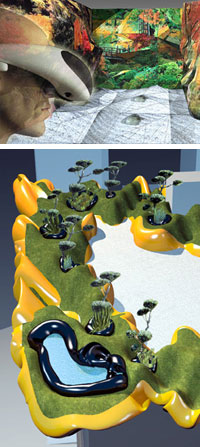 Spanish born garden designer Fernando Gonzalez is the principle and founder of Metagardens, a gardens design firm based in London. Fernando says that “the boundaries between the artificial and the organic are more blurred than ever before” and his innovative design practice seeks to address these challenges of the digital age through both built and experimental projects. Through computational techniques and an exploratory approach to design it proposes to go beyond the ordinary and conventional.
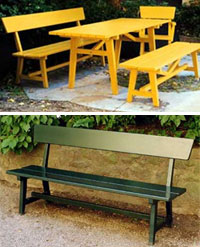 I really like the simple and familiar forms of this outdoor furniture suite designed by Peter Brandt for Swedish furniture maker Nola. The design is basic and almost utilitarian somewhat recalling national park furniture, but with gracious proportions and details.
 Being a web publication, I suppose we're a bit jaded when it comes to seeing Land+Living listed on another website... like earlier this week when we were listed among
  Nothing to do with the UK
  The free exhibition launches on 8 August at Sydney’s iconic Chifley Plaza and runs 9-19 August 2006. WORKSHOPPED differs from any other design showcase held in Australia because its main purpose is to foster promising talent and turn their ideas into a commercial reality; ready for the world stage. The exhibition will feature a range of design principles and materials including furniture, lighting, screens, installations and graphic design.
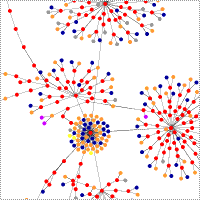 Here is an interesting way to look at the underlying code structure of a website. German blogger Ahref has written an app that graphically charts the hierarchy of a website's HTML tags. Shown on his site are graphs of many well known websites such as Google, CNN, Apple, etc.... pretty cool.
 This competition (sponsored by Building Design, SketchUp, et al.) "offers you the opportunity to stretch your creative mind to the full. The buildings, of course, are not going to be built - the aim is to see what you think is possible..." This is a sketch competition - not developed designs - and is open to architects, architectural technicians, students, designers and engineers.
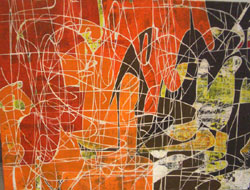 San Francisco Bay Area painter Laura Elisabeth Bauer creates abstract art works exploring nonobjective constructivism on canvas and sculptural forms. She counts modern masters Matisse, Miro, Mondrian, and Picasso among her influences as well as the period from 1920 through the 1950's, especially the abstract female artists Popova, Hepworth, and Hartigan.
 We're amping it up L+L a bit here with a slight update to our look and feel, and the addition of a new Branch to expand our offerings.
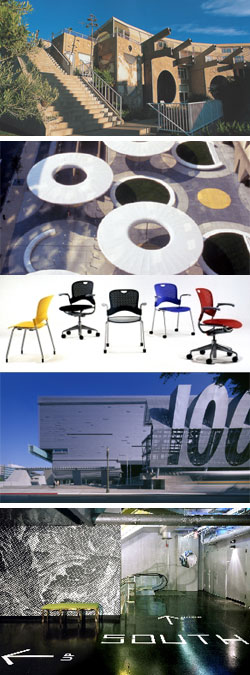 The Smithsonian’s Cooper-Hewitt, National Design has announced the winners of the seventh annual National Design Awards. The finalists and winners will be honored at an event on October 18, 2006.
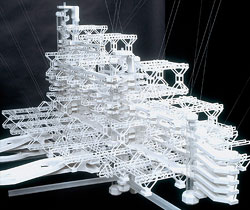 An exhibition at the Barbican Art Gallery in London running June 15, 2006 - September 17, 2006.
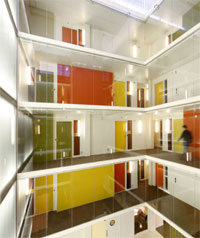 The Royal Architectural Institute of Canada (RAIC) and the Canada Council for the Arts have announced the winners of the Governor General's Medals in Architecture for 2006.
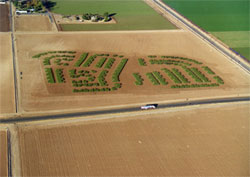 An exhibit at the Arizona State University Art Museum in Tempe, Arizona running September 9, 2006 - January 27, 2007.
 Nearly two years ago we were inundated with traffic after featuring the work of Brave Space Design. Specifically, it was their Tetris shelving that ignited the firestorm... people were like, freaking out. Totally.
 London based artist Joanna Sands bridges the realms of art and architecture by creating contextual sculptures which challenge and inform the perception of space. She began making large temporary sculptural installations in abandoned buildings in 1993, often using found materials. The use of dilapidated structures as a canvas brings to mind the work of Gordon Matta-Clark - the appropriation and investigation of cast off places. By making visually simple alterations to found spaces, Joanna subverts the spatial expectations of the viewer. These early pieces were ephemeral: constructed, documented, experienced as the venue for a "viewing" party, and then dismantled.
 San-Francisco-based designer Galya Rosenfeld has created a system that uses fabric scraps which can be attached and configured without glue, stitching, buttons, etc. to create a wide variety of objects. One of her creations from this ingenious system are Modular Pillows. The beauty of the system is that there are practically infinite configurations of colors and forms - damaged pieces can be replaced and the entire object can be disassembled and recycled.
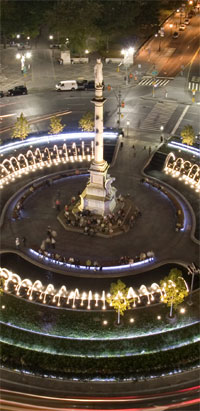 The American Society of Landscape Architects (ASLA) has announced the recipients of its 2006 Professional Awards. The jury considered over 500 entries and selected 32 projects to receive awards. The awards will be presented on October 9 at the ASLA Annual Meeting in Minneapolis.
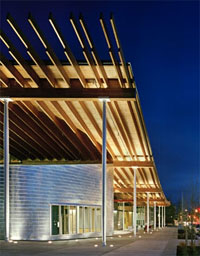 The American Institute of Architects (AIA) and its Committee on the Environment (COTE) have selected the top ten examples of sustainable architecture and green design solutions that protect and enhance the environment. The projects will be honored on May 3 during a presentation at the National Building Museum in Washington and again in June at the AIA 2006 National Convention and Design Exposition in Los Angeles.
 Even though the function of a chair as an aid to sitting has not really changed over time, its design has evolved in parallel to society. It has reflected the developments in technology, architecture, and industrial design. Furthermore, chairs have been a social, aesthetic, and symbolic statement. Chair design has been a declaration of attitudes, ideas, and viewpoints.
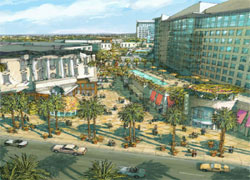 There is nothing more glamorous for an architect than designing America's malls... except perhaps designing 13,000 square foot faux-Tuscan additions to 9,000 square foot even-more-faux-Tuscan houses... ahem.
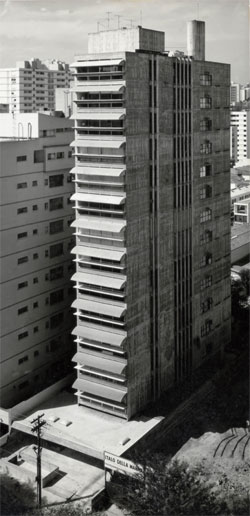 Paulo Mendes da Rocha of Brazil was announced today as the winner of the 2006 Pritzker Prize winner. The 77-year old architect is Brazil's second Pritzker laureate joining Oscar Niemeyer who was honored in 1988.
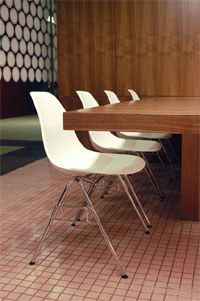 Albano Daminato is an interior architect and designer based in Singapore. His recent projects have included small scale hotels, private residences, retail stores, restaurants, bars and cafes, from overall concepts through to the design of furniture, objects and even uniforms.
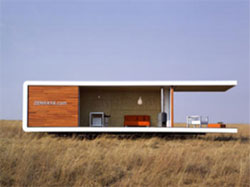 OK prefab junkies, here is your exotic South African prefab fix. Though we saw a bunch of prefab at
 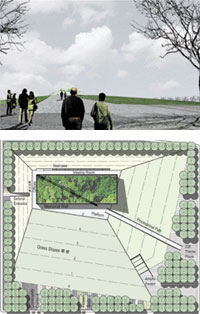 A UC Berkeley design team has won the competition for a 15-acre park in Chiayi, Taiwan, a monument to peace commemorating the 228 Incident - a tragedy which occurred on February 28, 1947, when government soldiers killed thousands of Taiwanese citizens. It was illegal to discuss the events of 1947 until 1992 when the Taiwanese government issued a formal apology.
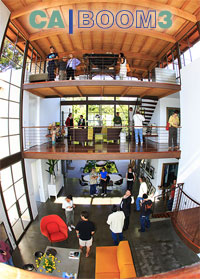 Weren't we just here? The third year of CA Boom is underway and we're here for the third time - only seven months after we wrapped up our coverage of last year's show. They have moved the date up a few months this year for whatever reason, but it works for me since the weather is a lot nicer... though it is cutting into a potential ski weekend...
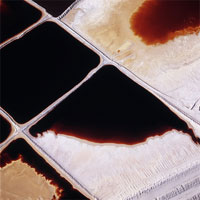 I know that I've seen Photographs by David Maisel before - his striking landscape images are impossible to forget - but it was just last week that I came across his wonderful "Oblivian" series of aerial photos of Los Angeles at
 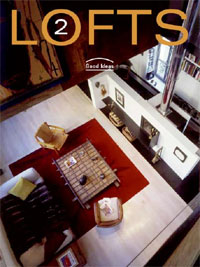 One of the things I like best about working at L+L is when we hear from people that being featured on L+L has led to good things.
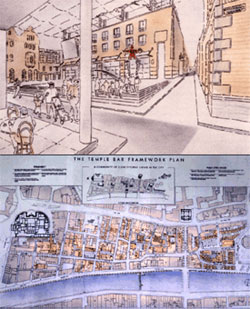 St. Patrick's Day seems an appropriate time to get back to my series on Ireland. Having looked at Dublin, both
  The 10th Architecture Week, the annual British public celebration of contemporary architecture, will be held June 16-25, 2006, in cities throughout the U.K.