

Derelict. Dilapidated. Discover. - Interventions in urban decay
 Detroit is one of the most spectacular examples of boom and bust in the United States - once opulent and then blighted - this capital of the Rust Belt is one of the nation's fastest shrinking cities and prime example of the phenomenon of "white flight" and, subsequently, sprawl. Large numbers of buildings and homes have been abandoned and many have been torn down or have fallen down and cleared away. Yet many vacant buildings remain in various states of decay.
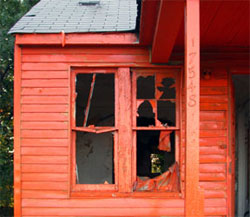
Preceding the recent Super Bowl held in Detroit, an anonymous group calling themselves the DDD Project (Detroit. Demolition. Disneyland.) began targeting highly visible abandoned structures for intervention. Marked with a circled "D" in chalk by the city for demolition by the city years prior, the DDD Project transformed the houses, creating highlights within a context of depression, with a coat of bright orange paint, covering every surface of the facade: "Every detail is accentuated through the unification of color. Broken windows become jagged lines. Peeling paint becomes texture."
Link: The Detroiter - Paint the Town Orange
Link: Michigan Radio - Urban Blight Gets a Paint Job
More: dETROIT fUNK - D.D.D.
More dETROIT fUNK - Tiggeriffic
More: hamtramck star
Via: Metafilter
Detroit's painful decline began in the 1950's, with the population cut nearly in half in 50 years with the loss of almost one million residents who moved to the suburbs. Urban decay followed along with crime and racial tensions. Vandalism and arson became common place in the deserted neighborhoods, especially on "Devil's Night" before Halloween.
BLOCKS OF DESERTED NEIGHBORHOODS ON THE EDGE OF DOWNTOWN DETROIT

Image via Forgotten Detroit
The City's urban renewal efforts through the razing of dilapidated structures have led to a sort of urban prairie taking hold as vast tracts of land revert back to nature. The city has almost turned inside out, with the surrounding countryside urbanized into a sprawling metropolitan region of shopping centers, office parks and suburban neighborhoods - people migrate to the suburbs while wild animals have moved into the city.
It is disturbing to consider the size of this city and the outlay for infrastructure and development over the years only to be largely abandoned even as surrounding land continued to be developed. Forget the arguments about the form of sprawl, it is this kind of waste that makes this kind of growth through sprawl and abandonment sickening to behold.
DISAPEARING NEIGHBORHOOD FABRIC, STREETS AND SIDEWALKS SERVE MORE VACANT LOTS THAN HOUSES

Image via Google Maps
The DDD Project targets the most visible abandoned homes, those visible to suburbanites who commute into Detroit and witness the burned out and forsaken neighborhoods. Two of the first nine houses painted by DDD have since been torn down by the City. There is something of the project that recalls Gordon Matta-Clark's (1, 2) "building cut" pieces; transforming deserted buildings with a simple gesture.
DETROIT. DEMOLITION. DISNEYLAND. PROJECT


GORDON MATTA-CLARK - WINDOW BLOW OUT, 1976 (LEFT) & SPLITTING, 1974 (RIGHT)

It is not only the residential neighborhoods of Detroit that have suffered, Downtown large office buildings, hotels and skyscrapers sit vacant and crumbling. The United Artists Building has been appropriated by graffiti artists who have painted the windows of the towering hulk, transforming the facade into an urban mosaic, and breathing life and change to an otherwise uninhabited and lifeless structure.
UNITED ARTISTS BUILDING

Image via Detroit Blog
Other artists and groups have addressed the issue of abandonment and decay in Detroit over the years as well.
Perhaps the best known is Tyree Guyton, founder of the Detroit based Heidelberg Project, a non-profit organization that seeks to empowers the residents of declining communities and neighborhoods through art. The DDD Project owes much to the inspiration of Tyree Guyton's Heidelberg Street where he decorated the outsides of abandoned houses with discarded objects gathered from the streets.
The University of Detroit Mercy School of Architecture Detroit Collaborative Design Center has explored the blighted city through various projects speculating on the urban transformation of Detroit.
SOUND HOUSE (LEFT) & HAY HOUSE (RIGHT)

Images via University of Detroit Mercy School of Architecture
Kate Ericson and Mel Zeigler
reminds me of heidelberg
me too
Old picturs for contrast
Hopeless
detroityes.com
i love detroit
Panamared
homegirl
History of a city
I miss the Detroit area
Land for parks
Decay and Development
awareness
Urban sprawl is the reason why Detroit's progress has been marginal
blight and decay in detroit
Unbelievable
N/A
detroit
watch who you vote for (00)
for those who still care
didnt have to be
No surprise
i need a paint and a roller!
Toledo isn't any better
Change calls for adaptation
Detroit's government
Detroit is coming back!
Detroit
Road to Recovery???
Late Great
How can you forget the Music?
Give Me a Break
I'll always love Detroit
End of the World, American Style
Sprawl?
wow
DET Demolition
It's not just the residents...
Nothing changes if nothing changes
Detroit rejects $200 million for Schools
Socialism
Detroit Recovery?
SHOCK!
you get what you vote for
memories of childhood
black bottom
interior photos
White House Hua Hin
move to Detroit???
Join a Gang
motorless city...
Just a Canadian Girl
Oh and yeah...
JOBS
Canadian Girl
First visit to Detroit
I would like to advertise on your website
You are all dreamers
why this far?
CrimeCapital
Send me your crackheads
Just visted Detroit for first time
Reply to ANON
One Word
Re-Building
DETROIT THE GREATEST OPPORTUNITY ON EARTH
Keeping my fingers crossed for Detroit
Mistake